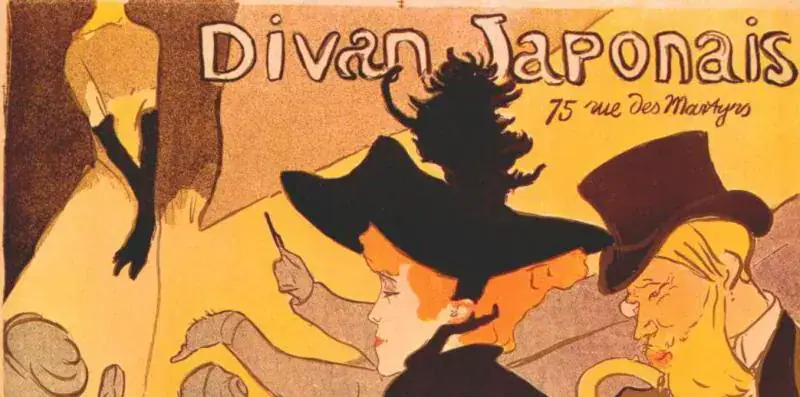
The late 19th century saw a significant development of establishments dedicated to popular song and entertainment in Paris. Between 1870 and 1918, numerous venues emerged in the capital and its outskirts, reflecting changes in urban sociability and the rise of a new spectacle culture. This cultural shift was marked by the intersection of literature, music, visual arts, and entertainment. Montmartre, particularly its hill, became a primary hub of this creative explosion.
The Chat Noir, founded by Rodolphe Salis, played a foundational role in this movement. Its immediate success was rooted in the convergence of writers, chansonniers, painters, and musicians on stage and in the audience. The cabaret organized evenings featuring popular airs and short theater pieces. Initially led by Aristide Bruant, the Chat Noir moved to larger premises in 1885, where shadow theater became a main attraction. This venue became a model for subsequent cabarets, with its collaborative approach among artists.
Aristide Bruant went on to open the Mirliton in 1885, in the same location as the first Chat Noir. At the Mirliton, Bruant developed a cabaret style based on direct interaction with the audience, often using radical insolence. His repertoire focused on Parisian underworld figures, with songs written in argot. The Mirliton offered a representation of the city that starkly contrasted with bourgeois norms. The venue gained notoriety, attracting a mix of curiosity seekers and those looking for a thrill.
In contrast to the more sensational establishments on the boulevards, the Lapin Agile offered an intimate setting for artistic sociability. Located at 4, rue des Saules, the Lapin Agile had a history predating the cabaret boom, initially operating as a tavern called Rendez-vous des voleurs in the 1860s. Its sign, created by André Gill, featured a rabbit escaping a saucepan, leading to its eventual name. The Lapin Agile maintained a cozy atmosphere conducive to singing and drinking with friends.
The cabarets of this era, including the Moulin Rouge and Folies Bergère, contributed to Paris becoming a major center for artistic creation and entertainment. Artists like Toulouse-Lautrec were associated with these venues, capturing their essence in his works. The Belle Epoque, marked by this flourishing of cabarets, was a time of significant cultural innovation in Paris.
Julien Morel, editor-in-chief of RetroNews since 2017, wrote about these developments, highlighting the role of cabarets in shaping Parisian nightlife. His article, published on November 24, 2026, and updated on November 25, 2026, was part of a partnership with the Saison Cabaret event, supported by the French Ministry of Culture.
The legacy of these fin-de-siècle cabarets continues to influence the cultural landscape of Paris. Their innovative blend of art, music, and entertainment set a precedent for future generations of artists and performers. Today, they remain iconic symbols of Paris's rich cultural heritage.
Key points
- The Chat Noir, founded by Rodolphe Salis, was a foundational venue in the development of Parisian cabarets.
- Aristide Bruant's Mirliton introduced a direct and radical interaction with the audience, focusing on Parisian underworld themes.
- The Lapin Agile offered an intimate, artistic sociability space, distinct from the more spectacular boulevard cabarets.