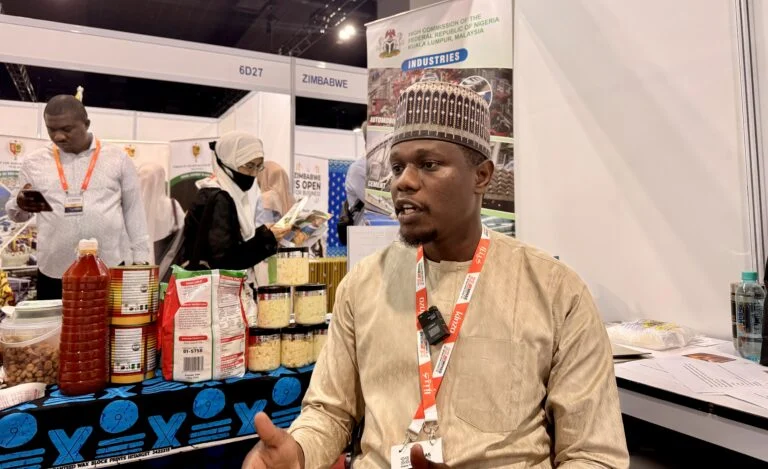
The Federal Government of Nigeria is developing a national Halal framework that will introduce a Quick Response (QR)-based certification system for Nigerian products. This system aims to facilitate traceability and access to international markets. The Special Assistant to the President on Export Expansion, Mr Aliyu Sheriff, disclosed this in an interview on the sidelines of the Malaysia International Halal Showcase (MIHAS) 2026 in Kuala Lumpur.
The framework will establish standards for certification, accreditation, and traceability, enabling international buyers to verify the source and compliance of Nigerian products. Sheriff stated that the government wants to have its own Halal mark with a QR-based code, allowing buyers to scan and trace products back to their factory of origin. This move is expected to help Nigerian businesses compete effectively in the international market.
The government’s strategy is built around four pillars: Islamic finance, Halal compliance, market access, capacity development, and infrastructure development. The compliance component will focus on standardization, accreditation, and technology, while the market access pillar will help Nigerian businesses connect with international markets. Sheriff emphasized the need for a structure in place for standardization, accreditation, and technology integration.
Nigeria is seeking to learn from countries with established Halal ecosystems, particularly Malaysia and Indonesia, while developing a framework suited to the Nigerian environment. Sheriff noted that Malaysia is the number one Halal-developed nation globally, and Nigeria needs partnerships with them. The government also plans to strengthen the capacity of Micro, Small, and Medium Enterprises (MSMEs) to meet international requirements.
The Halal economy should not be viewed exclusively as a Muslim market, as its principles also cover quality, safety, ethics, and sustainability. Sheriff stated that the concept of Halal extends beyond its Islamic origins, embodying ethics, integrity, and universal values that resonate across cultures and regions. The government is engaging businesses and regulators to broaden understanding of the economic opportunities presented by the global Halal market.
The strategy will also expand Nigeria’s participation beyond Halal food to sectors including modest fashion, tourism, hospitality, livestock, and other services. Sheriff said the government is finalizing a draft implementation framework following consultations with international partners. Capacity development activities involving international partners are planned for November, with the framework expected to be finalized before the end of the year.
The government is prioritizing value addition, as Nigeria must move away from exporting raw commodities to create jobs, generate foreign exchange, and increase its share of the global market. Sheriff emphasized the need for finished products, stating that adding value to products is essential. Nigeria’s position as a major African economy and gateway to the African Continental Free Trade Area (AfCFTA) provides an opportunity to expand its participation in the global Halal economy.
Key points
- The Federal Government of Nigeria is developing a national Halal framework with a QR-based certification system to facilitate traceability and access to international markets.
- The framework will establish standards for certification, accreditation, and traceability, enabling international buyers to verify the source and compliance of Nigerian products.
- The government aims to finalize the framework before the end of the year, with capacity development activities planned for November.