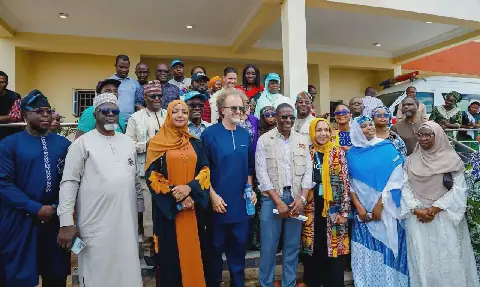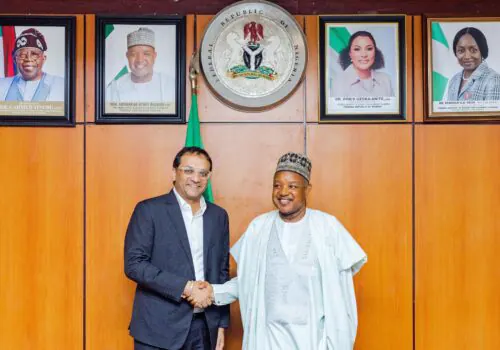
The Federal Government of Nigeria has expressed its willingness to collaborate with the United Nations High Commissioner for Refugees (UNHCR) and the private sector to create sustainable economic opportunities in communities affected by displacement. This initiative aims to mobilize investment and support the reintegration of displaced persons into productive economic activities. The Minister of Budget and Economic Planning, Senator Abubakar Atiku Bagudu, made this statement during a meeting with the UNHCR team.
Senator Bagudu emphasized that displacement disrupts livelihoods, weakens local economies, and can deepen poverty if affected populations are not reintegrated into productive economic activity. He noted that people forced to leave their communities due to insecurity or natural disasters often abandon farms, fishing grounds, livestock, and other sources of livelihood. The restoration of economic opportunities is critical to sustainable reintegration, and the government is seeking to localize development planning to address the specific needs and opportunities across Nigeria's 8,809 wards.
The proposed Leadership Alliance for Enterprise, Acceleration, and Prosperity (LEAP) initiative aims to mobilize private investment for displacement-affected and fragile communities. Senator Bagudu stated that the initiative aligns with Nigeria's long-term development aspirations, particularly the objective of building a more productive, inclusive, and investment-driven economy. The goal is to create a $1 trillion economy that is inclusive and creates opportunities across communities.
Prolonged displacement can undermine family structures, social cohesion, and economic productivity, and rehabilitation and reintegration ultimately require jobs and sustainable economic opportunities. Senator Bagudu recalled his experience as Governor of Kebbi State, where he witnessed the impact of displacement on communities and the importance of economic opportunities. He stressed that displacement is not merely a question of where people live, but also of the quality and scale of economic opportunities available to them.
The Federal Government is seeking to develop practical de-risking mechanisms to encourage responsible private investment in vulnerable communities. Senator Bagudu identified security support, access roads, and other critical infrastructure as areas where public intervention can unlock private investment. The government is also exploring the use of the National Credit Guarantee Agency and insurance mechanisms to reduce investment risks in vulnerable communities.
The UNHCR Representative in Nigeria, Mr. Arjun Jain, stated that the organization is seeking to move beyond traditional humanitarian assistance by promoting sustainable livelihoods, self-reliance, and private-sector investment for displaced and host communities. UNHCR's engagement with displaced communities has consistently shown that people want opportunities to rebuild their lives, particularly through employment and sustainable livelihoods.
Nigeria hosts millions of internally displaced persons, alongside refugees and asylum-seekers from other countries, creating an urgent need for solutions that go beyond short-term humanitarian support. The UNHCR's current operation in Nigeria identifies more than 3.7 million internally displaced persons, and the organization is working with the government and other partners to address the challenges faced by these communities.
Key points
- The FG, UNHCR, and private sector will collaborate to create sustainable economic opportunities in communities affected by displacement.
- The LEAP initiative aims to mobilize private investment for displacement-affected and fragile communities.
- The government is seeking to develop practical de-risking mechanisms to encourage responsible private investment in vulnerable communities.