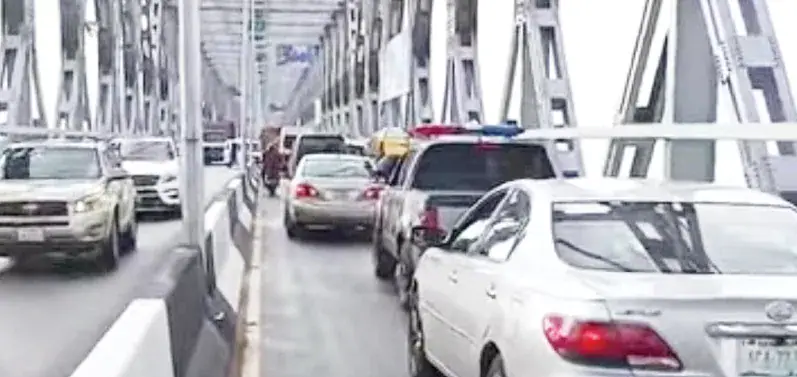
The Federal Government of Nigeria is contemplating a ban on heavy vehicles using the First Niger Bridge, a vital transportation link between Onitsha, Anambra State, and Asaba, Delta State. This move aims to alleviate persistent gridlocks on the bridge, which have worsened since its reopening on October 15, 2026, after a period of closure due to structural vandalism. The bridge's reopening introduced new road demarcations and medians, which have narrowed the lanes and contributed to traffic congestion.
The Anambra State Federal Controller of Works, Timothy Emenike, revealed that the government is exploring measures to ease traffic flow on the bridge, particularly as the Yuletide season approaches. He attributed the gridlock to drivers' failure to park broken-down vehicles in a way that does not obstruct traffic. Emenike noted that the ministry had considered the bridge's design and ensured that two vehicles could pass at a time before implementing the new demarcations. However, he acknowledged that some drivers intentionally park their vehicles in a way that blocks traffic.
The First Niger Bridge was initially closed on September 7, 2026, due to severe structural vandalism, including missing bolts, cut steel components, and damaged expansion-jointed steelwork. Upon reopening, motorists and commuters observed that broken-down trailers and heavy-duty trucks frequently become trapped or stuck within the tight, newly-demarcated lanes, completely blocking traffic flow. This has led to widespread complaints and criticism of the new physical dividers.
Motorists and drivers have expressed mixed views on the demarcation, with some blaming it for the gridlock. They argue that the new concrete demarcations make it difficult for another vehicle to navigate whenever a vehicle breaks down. Some have called for the provision of towing vans at both ends of the bridge to facilitate the easy removal of broken-down vehicles.
The proposed ban on heavy vehicles using the First Niger Bridge is expected to free up space and allow for easier traffic flow. The government is considering diverting these vehicles to the Second Niger Bridge, which is wide enough to accommodate them. Emenike urged drivers, especially those operating heavy-duty vehicles, to ensure their vehicles are in good condition before plying the road.
Drivers and motorists have been advised to be more intentional in parking their vehicles in a way that does not obstruct traffic. Emenike emphasized that vehicles do not break down suddenly and that drivers can take steps to clear the road when they notice faults with their vehicles. The government is exploring various measures to ease traffic congestion on the bridge.
The planned ban on heavy vehicles using the First Niger Bridge is part of a broader effort to address the persistent gridlocks plaguing the bridge. A barrier may be placed at both ends of the bridge to prevent heavy-duty trucks from plying the bridge, and towing vans may be provided to facilitate the easy removal of broken-down vehicles.
Key points
- The Federal Government is considering diverting heavy-duty vehicles to the Second Niger Bridge to ease traffic congestion on the First Niger Bridge.
- The proposed ban on heavy vehicles aims to alleviate persistent gridlocks on the First Niger Bridge.
- Drivers have been urged to ensure their vehicles are in good condition and to park broken-down vehicles in a way that does not obstruct traffic.