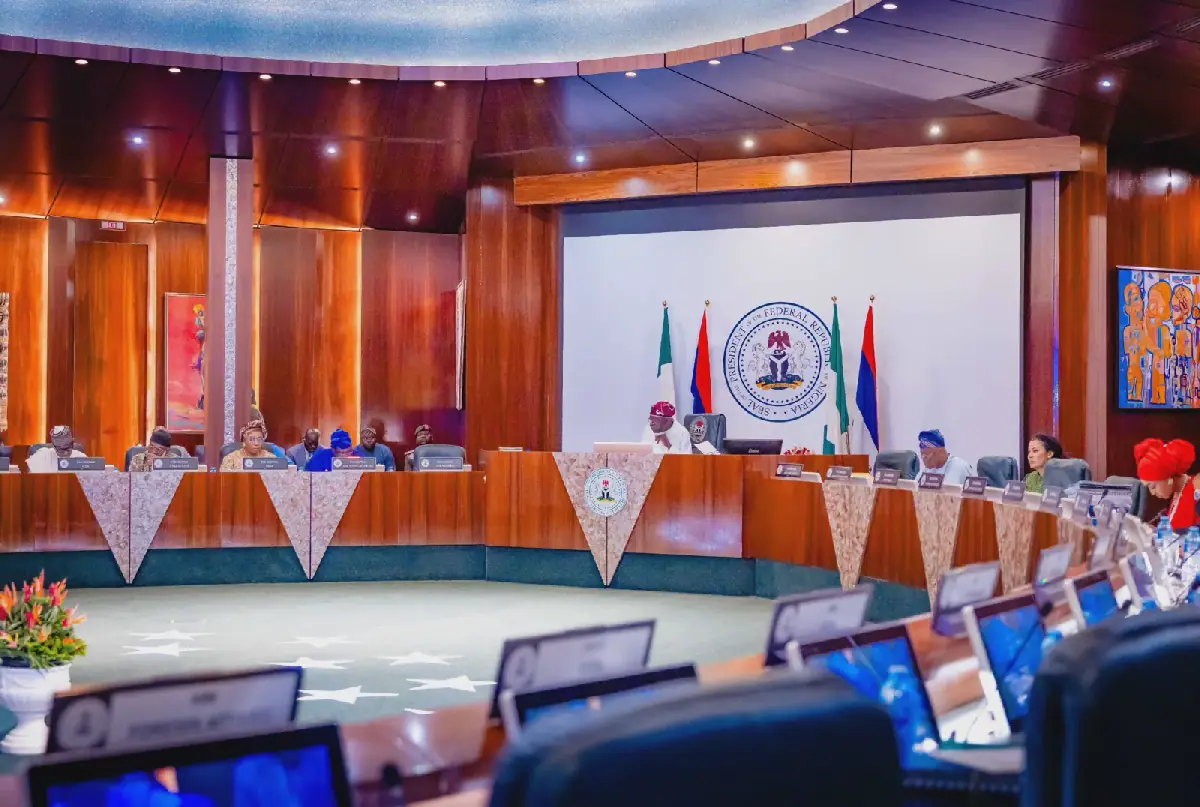
The Federal Executive Council (FEC) has approved a N45.8 billion biosecurity and disease surveillance system for five international airports in Nigeria. This move aims to strengthen the country's defense against Ebola and other pathogens. The council, presided over by President Bola Tinubu, also approved three major electricity transmission projects to improve grid stability and expand transmission capacity.
The biosecurity project, implemented under a 20-year public-private partnership concession awarded to BioHealth Consortium, will be deployed at five international airports: Murtala Muhammed International Airport, Lagos; Nnamdi Azikiwe International Airport, Abuja; Mallam Aminu Kano International Airport, Kano; Port Harcourt International Airport; and Akanu Ibiam International Airport, Enugu. The project includes wastewater surveillance, air and surface sampling equipment, and technologies for monitoring cargo and baggage.
The Federal Government has defended its N100,000 support for people placed in quarantine after being identified as contacts of an Ebola patient. The Coordinating Minister of Health and Social Welfare, Prof. Ali Pate, explained that this intervention is necessary to encourage compliance and prevent community transmission. The support targets ensuring that identified contacts comply with quarantine requirements, protecting the wider population from possible infection.
The Minister of Power, Joseph Tegbe, disclosed that the Federal Government has paid N1.2 trillion out of the N2.3 trillion owed to electricity sector operators. This payment aims to ease liquidity constraints, improve gas supply to generating companies, and stabilize electricity delivery nationwide. The government is targeting an increase in the country's electricity transmission capacity from about 5,000 megawatts to more than 19,000 megawatts.
The new biosecurity system will establish a National Surveillance Operations Centre to coordinate real-time monitoring, integrate data, track incidents, and support rapid responses to suspected outbreaks. Modern laboratories will be provided for rapid diagnostics at points of entry, while operations will be integrated with those of the Nigeria Centre for Disease Control and Prevention (NCDC), Port Health Services, and other agencies.
The threat of Ebola remains, given the continued spread of the disease in the Democratic Republic of the Congo (DRC) and the possibility of other infectious diseases entering Nigeria. The government is pursuing a two-pronged strategy of containing the existing Ebola threat while strengthening border surveillance to prevent new cases from entering the country.
The FEC's decisions aim to strengthen national health security, address liquidity challenges in the electricity industry, and improve power supply. The government expressed confidence that the new system would improve Nigeria's capacity to detect emerging threats, coordinate responses across agencies, and protect the country against future public-health emergencies.
Key points
- The FEC approved a N45.8 billion biosecurity and disease surveillance system for five international airports.
- The Federal Government paid N1.2 trillion out of the N2.3 trillion owed to electricity sector operators.
- The government is targeting an increase in the country's electricity transmission capacity from about 5,000 megawatts to more than 19,000 megawatts.