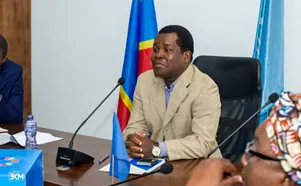
The Food and Agriculture Organization (FAO) of the United Nations has commended the progress achieved in implementing the project "Leveraging Digital Systems for Emergency Preparedness and Response to Food Crises" in Idiofa, Kwilu province, in the southwestern part of the Democratic Republic of Congo. This was during an exchange organized by the supervision mission of the African Development Bank (AfDB) in Kinshasa on October 1, 2026.
Judicaël Pazou, Operations Officer, speaking on behalf of the Deputy Representative of the FAO, praised the results obtained in Idiofa, describing them as encouraging and a testament to the commitment of all stakeholders. He noted significant advances in strengthening the governance of the early warning system, particularly through the formalization of the Provincial Working Group on Alert and Early Action in Kwilu.
The project has also developed several technical tools, frameworks, protocols, and procedures to support data collection, analysis, and sharing for informed decision-making. Furthermore, the project has invested in strengthening the material and technological capacities of the actors involved, including the acquisition and provision of computer and digital equipment to support field activities and improve information management.
The project has made notable progress in developing and launching digital platforms, including the early warning system and the SeedTracker seed information management platform. Configuration, parameterization, and initial tests have laid the foundations for solutions aimed at improving the availability of strategic data and the effectiveness of interventions in favor of food security and population resilience.
A representative of the AfDB praised the existence of the Provincial Working Group on Alert and Early Action in Kwilu, the adoption of new technologies, and the involvement of state services, which constitute a basis for the sustainability of this strategic initiative. However, the representative noted that the true value of these achievements is not measured solely by the number of infrastructures and tools developed but by their effective and sustainable use by the institutions and actors for whom they are intended.
Judicaël Pazou reaffirmed the FAO's commitment to accompanying the Government of the Democratic Republic of Congo in strengthening its capacities for preparedness, anticipation, and response to emergency situations through digital technologies, early warning systems, and anticipatory action mechanisms. He also emphasized the quality of collaboration with the AfDB, whose support and trust are essential for advancing this common vision.
The meeting was attended by delegates from the National Seed Service (Senasem), the National Institute for Agricultural Research (Inera), the International Institute of Tropical Agriculture (IITA), the Directorate of Archives and New Information and Communication Technologies (Dantic), and the National Program for Food and Nutritional Security (Prosana).
Key points
- The FAO has praised the progress made in the early warning system for food security in Idiofa, Kwilu province, Democratic Republic of Congo.
- The project has developed several technical tools, frameworks, protocols, and procedures to support data collection, analysis, and sharing for informed decision-making.
- The FAO has reaffirmed its commitment to accompanying the Government of the Democratic Republic of Congo in strengthening its capacities for preparedness, anticipation, and response to emergency situations.