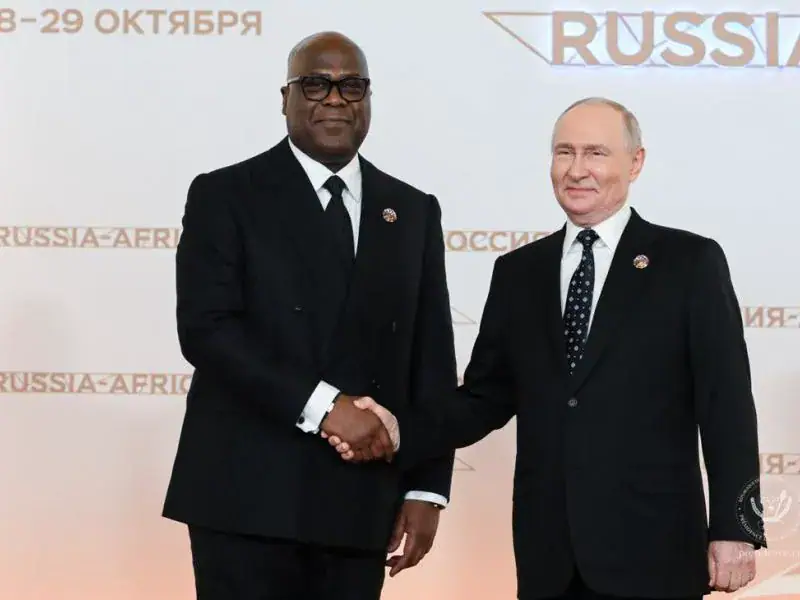
On October 29, 2026, Democratic Republic of the Congo (DRC) President Félix Tshisekedi spoke at the third Russia-Africa Summit in Moscow, Russia. During his address, Tshisekedi emphasized the need for a multipolar world, allowing each state to exercise its sovereignty. He highlighted the importance of respecting the United Nations Charter, territorial integrity, and peaceful conflict resolution. The DRC is currently facing a severe security crisis in its eastern region, where ongoing hostilities and the transformation of the AFC/M23 rebellion into the Front pour la refondation de la nation (FRN) have led to significant humanitarian concerns.
Tshisekedi expressed his support for ongoing diplomatic initiatives, including the Washington and Doha processes, aimed at restoring peace in eastern DRC. These processes have the backing of the African Union, the United States, and Qatar. The DRC president acknowledged progress made in recent months but stressed that effective implementation and verification on the ground are crucial. He also recalled the requirements of UN Security Council resolutions 2773 and 2808, which include the cessation of hostilities, withdrawal of Rwandan forces from DRC territory, and an end to support for armed groups.
The DRC president lamented the slow implementation of these resolutions, despite the country's commitment to its obligations. He called on all parties to adhere to the same level of rigor, emphasizing that the DRC respects its commitments. Tshisekedi specifically requested Russia's involvement in implementing these resolutions, given its permanent membership in the UN Security Council. He urged Russia to support mediation efforts and ensure the protection of civilians, humanitarian access, and the voluntary return of displaced persons.
The crisis in eastern DRC remains a significant concern for the Congolese authorities and the international community. The conflict has led to substantial humanitarian consequences, with ongoing clashes between the DRC military and the FRN, previously known as AFC/M23. The FRN is now led by former DRC President Joseph Kabila. Tensions between Kinshasa and Kigali, as well as the humanitarian impact of the conflict, continue to test diplomatic efforts aimed at restoring peace and stability in the Great Lakes region.
The DRC government continues to denounce Rwanda's alleged support for the FRN. The international community is promoting peace processes, including the Washington talks between Kinshasa and Kigali, facilitated by the United States, and the Doha discussions between Kinshasa and the FRN, supported by the African Union. Despite diplomatic progress, the gap between announcements and on-the-ground reality persists, prompting calls for parties to respect their commitments under current peace initiatives.
During the Russia-Africa Summit, Tshisekedi also emphasized the importance of diversifying partnerships to strengthen the DRC's freedom of decision in serving its population. The summit provided a platform for African leaders to engage with Russian President Vladimir Putin and other global stakeholders. Tshisekedi's address highlighted the DRC's commitment to finding peaceful solutions to its security challenges and promoting cooperation with international partners.
The DRC's eastern region has faced prolonged instability, with the conflict affecting millions of people. The international community continues to support efforts to restore peace and stability in the region. As the DRC navigates its relationships with global partners, Tshisekedi's address at the Russia-Africa Summit underscored the country's commitment to finding sustainable solutions to its security challenges.
Key points
- The DRC president reaffirmed his country's commitment to peace processes in eastern DRC, including the Washington and Doha initiatives.
- Tshisekedi requested Russia's involvement in implementing UN Security Council resolutions aimed at resolving the conflict.
- The DRC continues to face significant security and humanitarian challenges in its eastern region, with ongoing clashes and diplomatic efforts to restore peace.