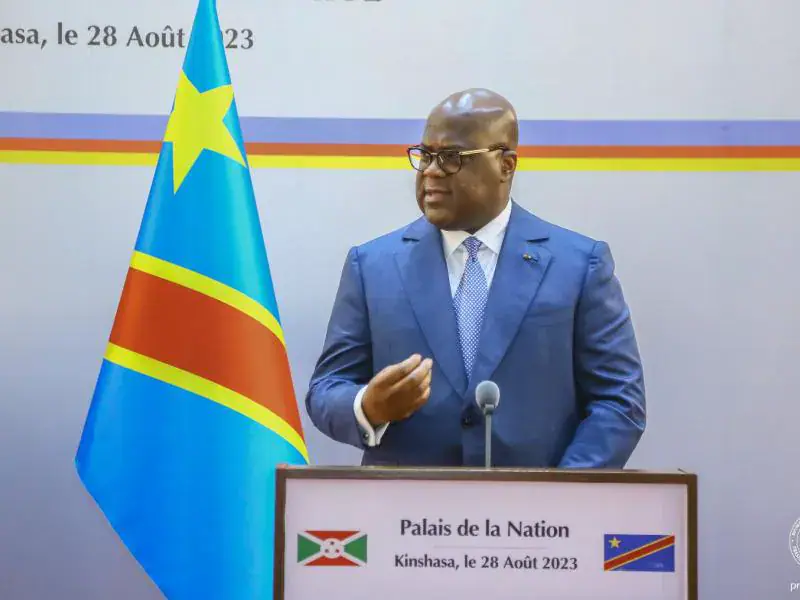
On October 30, 2026, in Moscow, Russia, Félix Tshisekedi, President of the Democratic Republic of the Congo (DRC), spoke to the Congolese community about his vision for the country's future. With two years left in his term, Tshisekedi emphasized his commitment to restoring peace and security, and putting the country back on track for development. He described himself as a "passenger" and stressed that his mission is to prepare the country for a smooth transition to his successor.
Tshisekedi's comments come amid ongoing conflict in the eastern DRC, where the M23 rebellion, backed by Rwanda, continues to cause instability. In contrast to his predecessor, Joseph Kabila, who has taken up arms as part of the AFC/M23 rebellion, now known as FRN, Tshisekedi reaffirmed his loyalty to the country and its institutions. He stated that he would never take up arms against his own country, instead choosing to work within the system to bring about change.
The President highlighted the history of his political party, the UDPS, which has consistently rejected the use of violence to achieve power. Tshisekedi recalled that, even during the tumultuous 1980s, the party, under the leadership of Étienne Tshisekedi wa Mulumba, had resisted proposals from neighboring countries to take up arms against the regime. This stance, he emphasized, has always guided his own approach to politics.
Tshisekedi's address was part of his participation in the 3rd Russia-Africa Forum, where he engaged with various stakeholders on issues affecting the continent. The Congolese leader expressed his willingness to collaborate with his successor, offering advice and guidance to ensure the country's continued progress. He encouraged the Congolese people to support his efforts, emphasizing that collective action is essential for achieving peace and stability.
The ongoing conflict in the DRC has sparked concerns about the gap between diplomatic progress and the security situation on the ground. Despite agreements, such as the Washington Accords between Kinshasa and Kigali, and the Doha process, fighting persists. Tshisekedi's commitment to finding a peaceful solution is seen as crucial in addressing these challenges and promoting regional stability.
The DRC President's statements have been welcomed by various stakeholders, who see his emphasis on dialogue and cooperation as a positive step towards resolving the country's crisis. As the situation in the eastern DRC remains volatile, Tshisekedi's leadership and vision will be closely watched by both domestic and international observers.
The Congolese government faces significant hurdles in restoring peace and stability, particularly in the face of external support for rebel groups. Tshisekedi's resolve to address these challenges, while promoting national unity and development, will be critical in shaping the country's future. His engagement with the Congolese community in Moscow reflects his efforts to build bridges and mobilize support for his vision.
Key points
- Félix Tshisekedi emphasizes his commitment to restoring peace and security in the DRC without taking up arms against his own country.