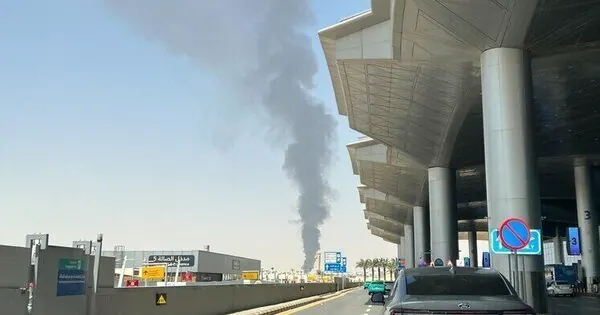
Air raid sirens sounded in Riyadh for the first time since fighting with Yemen's Houthis reignited in July. Several explosions were reported in the Saudi capital, disrupting flights and triggering air raid warnings. Saudi authorities sent emergency alerts early on Saturday, warning residents of a "hostile aerial threat" and urging them to remain indoors.
Explosions were reportedly heard across the city before the civil defense agency issued an all-clear about half an hour later. It was the first such warning in Riyadh since fighting in neighboring Yemen intensified in July. The latest escalation began in July after Saudi strikes on Yemen's Sanaa International Airport shattered a fragile truce dating back to 2022.
A large plume of black smoke and flames was seen near King Khalid International Airport. Reuters footage showed smoke rising from the airport's fuel-storage area, while flight-tracking service Flightradar24 reported major delays and cancellations. Saudi authorities have not disclosed the cause of the explosions or provided details on casualties or damage.
The Houthis, who control much of northern Yemen, have made significant territorial gains in recent weeks, advancing along the Red Sea coast and seizing strategic positions around the Bab el-Mandeb Strait. The advances have put further pressure on Saudi Arabia's oil exports, which have increasingly relied on Red Sea routes.
Maritime tracking data cited by AFP showed Saudi exports through the waterway have declined since July, although several loaded vessels passed through over the past week. The Houthis say international shipping remains unaffected, with the exception of Saudi vessels. The disruption has already hit crude supplies, with state oil giant Saudi Aramco telling European refiners they will receive no crude in October.
Oil prices are hovering above $100 a barrel. The escalation has raised concerns about the impact on global oil supplies. The US Central Command has reaffirmed its commitment to securing the Strait of Hormuz, a critical waterway for international oil shipments.
The situation remains volatile, with both sides exchanging attacks. The international community is watching closely, as the conflict threatens to destabilize the region further.
Key points
- The escalation began in July after Saudi strikes on Yemen's Sanaa International Airport shattered a fragile truce dating back to 2022.
- The Houthis have made significant territorial gains in recent weeks, advancing along the Red Sea coast and seizing strategic positions around the Bab el-Mandeb Strait.
- The disruption has already hit crude supplies, with state oil giant Saudi Aramco telling European refiners they will receive no crude in October.