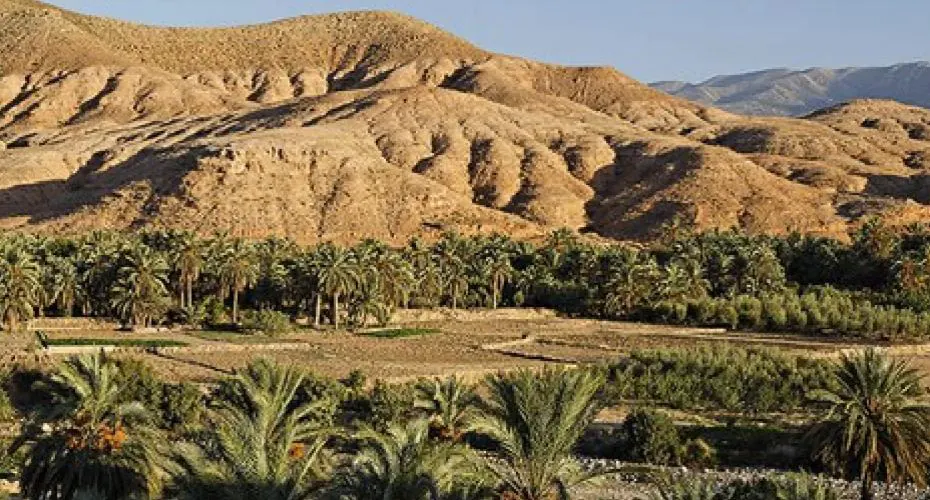
Nestled in the Aurès region of Algeria, the village of Madrunet, also known as Madrun or Madront, is a treasure trove of history and natural beauty. Located on a hillside, the village offers stunning views of the surrounding landscape. The name Madrunet is believed to have originated from the name "Nadruna" of Tlemcen, with some modifications to differentiate between the two. The village's history dates back to the arrival of its founders, who migrated from western Algeria and settled in the Aurès region.
The village of Madrunet was founded by the Sheikh Sidi Al-Hashimi, a prominent figure from the Dardour family, who built the village of Haidous, the sister village of Madrunet. Haidous is considered one of the oldest villages in the southwestern Aurès region. The Sheikh's descendants continued to play an important role in the region, with his nephew, Sheikh Ali Dardour, taking over the management of the Zawiya Rahmaniyah, a center for Islamic learning and community services.
The Zawiya Rahmaniyah, established by Sheikh Sidi Al-Hashimi, was a hub for Islamic learning, community services, and social activities. The Zawiya provided food, shelter, and medical care to the poor, orphans, and travelers. It also offered Quranic education and traditional medicine. After Sheikh Sidi Al-Hashimi's death in 1899, his body was buried in Madrunet. The Zawiya continued to thrive under the leadership of his successors, including Sheikh Ali Dardour and his niece, Lalla Aziiza.
Lalla Aziiza played a crucial role in maintaining the Zawiya's activities and services. Before her passing in 1958, she entrusted the management of the Zawiya to Sheikh Bashir, the father of Dr. Abdel Basset Dardour. Sheikh Bashir continued to serve the community, but eventually had to leave the Zawiya due to difficult circumstances. The Zawiya had produced notable figures, including Sheikh Omar Dardour, known as "Ibn Badis of Aurès," who advocated for Islamic education.
The village of Madrunet and the Zawiya Rahmaniyah played a significant role in the Algerian struggle for independence. Sheikh Mohammed Al-Hashimi Dardour, a prominent figure in the resistance, used the Zawiya as a base for mobilizing support and providing assistance to fighters. The Zawiya also served as a refuge for freedom fighters and a center for disseminating information and awareness about the revolution.
The French colonial authorities attempted to win over Sheikh Mohammed Al-Hashimi Dardour and undermine his support for the resistance. However, he remained committed to the cause, using his cunning and strategic thinking to evade their attempts to capture him. The Zawiya's contributions to the Algerian struggle for independence are still remembered and celebrated today.
Today, the village of Madrunet and the Zawiya Rahmaniyah remain an important part of Algeria's cultural and historical heritage. Despite the challenges posed by time and neglect, the village and the Zawiya continue to attract visitors and scholars interested in exploring the region's rich history and natural beauty. The legacy of Madrunet serves as a testament to the resilience and determination of the Algerian people.
Key points
- The village of Madrunet was a major center for Islamic learning and community services in the Aurès region.
- The Zawiya Rahmaniyah played a significant role in the Algerian struggle for independence.
- The village and Zawiya continue to be an important part of Algeria's cultural and historical heritage.