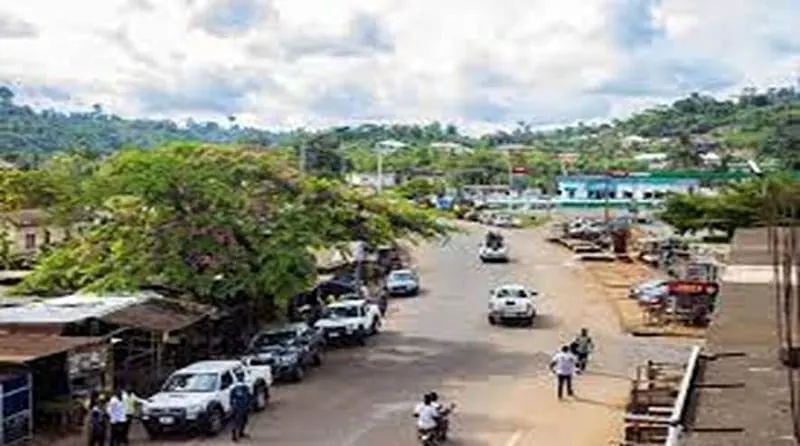
The Western North Region, established in 2019, is a new region carved out of Ghana's former Western Region. It shares borders with the Ivory Coast's Comoé District to the west, the Central Region to the southeast, and the Ashanti, Ahafo, Bono East, and Bono regions to the north. The region operates under the local government system, comprising nine MMDAs, three Municipal, and six District Assemblies. Each district, municipal, or metropolitan assembly is led by a chief executive representing the central government but accountable to an assembly chaired by a presiding member chosen from among its members.
The government proposed establishing a regional hospital in each new region, including the Western North Region. The traditional leaders of Sefwi Wiawso, particularly the Nananom, designated a substantial plot of land in Sefwi Domeabra, a suburb of the regional capital, for the hospital's construction. However, recent reports indicated that the hospital would be built at the Benchema barrier in the Juaboso Constituency, sparking disapproval from Nananom and other opinion leaders who were not informed of the decision.
The Benchema Barrier, a small settlement with approximately 15 houses and inadequate educational facilities, is not an ideal location for a regional hospital. A regional hospital serves a larger geographic area, providing specialized medical treatments, emergency response, and routine exams for peripheral or rural populations, reducing travel distances. Concentrating high-volume services and complex procedures in regional hubs reduces hospitalization days, lowers mortality rates, and simplifies administrative costs.
Sefwi Wiawso, the regional capital, offers several benefits as a location for the hospital. Centralized investment enables regional centers to acquire diagnostic and surgical equipment that would otherwise be cost-prohibitive. Large regional hospitals in regional capitals serve as primary local employers and economic multipliers, encouraging stable employment opportunities and sustaining auxiliary community business activity. They also form the foundation for nearby telehealth networks and clinics, ensuring efficient patient referrals and standardized clinical protocols.
Opening hospitals in cities or regional capitals rather than villages or settlements like Benchema Barrier brings many operational, economic, clinical, and social benefits. A thriving hospital system and strong employment opportunities increase demand for schools, housing, transportation, and other services. Companies seeking to expand consider the availability of healthcare services when deciding to relocate or establish themselves in a community.
In contrast, rural areas like Benchema Barrier face challenges such as low population density, lowered patient volumes, and diseconomies of scale. These areas often struggle to attract and retain a highly educated workforce due to limited urban amenities, educational systems, and career opportunities for spouses. Additionally, rural locations complicate logistics, including deliveries of medical gases, blood products, and specialized medications, and often have inadequate infrastructure, including reliable electrical supply and high-speed internet.
Experts argue that constructing a regional hospital in a village is generally not advisable due to the lack of population density, specialized workforce, and infrastructure necessary to support large-scale healthcare facilities. A regional capital like Sefwi Wiawso is a more suitable location for such a facility, offering a central location, existing infrastructure, and economic benefits that can support a thriving hospital system and contribute to the region's growth and development.
Key points
- Sefwi Wiawso's central location and existing infrastructure make it an ideal site for the Western North Regional Hospital.
- A regional hospital in a rural location like Benchema Barrier would face significant challenges, including low population density and limited access to specialized workforce and infrastructure.
- Constructing the hospital in Sefwi Wiawso would bring operational, economic, clinical, and social benefits to the region, including increased employment opportunities and improved access to healthcare services.