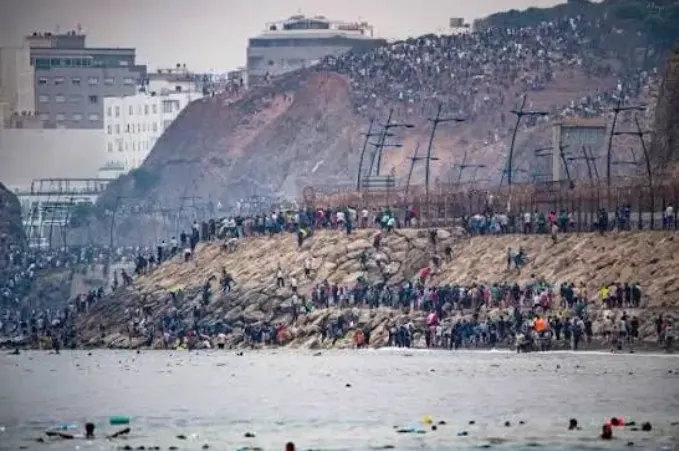
Spanish security experts and journalists have accused Morocco of waging a hybrid and covert war against Spain. They claim Morocco is using irregular migration and espionage to pressure Madrid into achieving political and financial goals. According to Fulgenzio Coll, former head of the Spanish Army's ground forces, Morocco's actions in the city of Ceuta last July were a "invasion" and not just a migration crisis.
Coll described the events in Ceuta as part of a strategic pressure campaign with political undertones. He called for increased military presence in Ceuta and suggested using economic and trade tools to counter Morocco's pressure. Meanwhile, investigative journalist Jose Bautista alleged that Morocco's intelligence services, using the Israeli "Pegasus" program, are waging a covert war against Spain.
Bautista criticized Morocco's authoritarian system, describing it as a dictatorship masquerading as a democracy. He claimed that Morocco's intelligence services lost control of migrant flows, leading to the crisis in Ceuta. Bautista argued that Morocco is not a law-based country and that its security forces operate with wide latitude, disregarding democratic rules, even against Spain.
The journalist pointed to a recent investigation into Morocco's intelligence services, which exposed sensitive information. He mentioned the influential role of King Mohammed VI's advisor, Fouad Ali El Himma, and the head of internal intelligence and police, Abdel Latif Hammouchi. Bautista emphasized that there is no press freedom in Morocco and that the country uses cooperation in counter-terrorism and migration to exert political pressure.
Bautista described Morocco as a dictatorship hiding behind a democratic facade. He criticized Morocco's attempts to market itself as a model of democracy and human rights. According to Bautista, Morocco selectively cooperates in counter-terrorism and migration, depending on its diplomatic relations and interests.
The allegations against Morocco have raised concerns about its actions and their implications for Spain and the region. Experts and journalists continue to investigate and expose Morocco's tactics. The situation remains a point of contention between the two countries.
The use of irregular migration and espionage as tools of pressure has significant implications for regional stability. Spain and Morocco have a complex relationship, with tensions often arising over issues like migration and territorial disputes.
Key points
- Morocco accused of waging hybrid and covert war on Spain using irregular migration and espionage.
- Experts call for increased military presence and economic countermeasures against Morocco.
- Journalist alleges Morocco's authoritarian system and lack of press freedom.