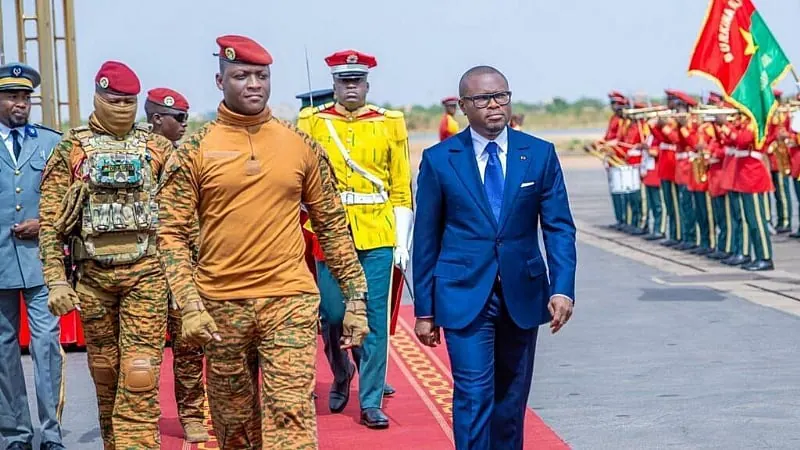
On September 30, 2022, Captain Ibrahim Traoré seized power in a coup in Ouagadougou, promising to restore security in Burkina Faso, which was struggling with a jihadist insurgency. Traoré vowed to continue the legacy of Thomas Sankara, a former leader who championed Pan-Africanism and national autonomy. However, Ouédraogo notes that Traoré's regime has become increasingly repressive, with journalists, magistrates, and civil society members regularly abducted and sent to the front lines.
Inoussa Ouédraogo, the former publishing director of the weekly Bendré, now lives in exile. He believes that Traoré's new economic projects, such as a gold refinery and highway construction, are a positive development but serve as a distraction from the country's deteriorating human rights situation. Ouédraogo's organization, the Anti-Putschist Front, has documented over 200 people abducted, held captive, and tortured by the regime, including journalists, doctors, and religious leaders.
Traoré has openly asserted that Burkina Faso is not a democracy, sparking concerns about his intentions. Ouédraogo argues that Traoré's actions are a clear indication of his desire to consolidate power and silence dissent. The exiled publisher emphasizes that democracy and human rights are essential for the country's development and that Traoré's regime is undermining these fundamental principles.
Despite Traoré's claims of being a proponent of sovereignty, Ouédraogo disputes this notion, arguing that the struggle for sovereignty cannot justify human rights abuses and the suppression of democracy. He notes that Pan-Africanists have historically fought for African liberation without undermining their own people or subverting their constitutions. Ouédraogo stresses that the true liberation of Africa requires respecting the rights and freedoms of its people.
Traoré's regime has been marked by numerous repressive measures, which the government justifies as necessary to combat the jihadist threat. However, Ouédraogo believes that this is simply a pretext to hold onto power. He expresses concern about the thousands of people displaced, the loved ones of abducted individuals, and the overall suffering of the Burkinabé people.
In early 2025, Traoré visited Ghana for President Mahama's inauguration ceremony, where he received a standing ovation from thousands of people. Ouédraogo explains that popularity abroad does not necessarily translate to legitimacy, emphasizing that what matters most is improving the lives of one's people. He questions whether the living conditions of the Burkinabé people have changed, citing the ongoing struggles with terrorism and displacement.
Ouédraogo disputes Traoré's claim that jihadists have lost ground in Burkina Faso over the past four years, citing the reality on the ground and the daily struggles of the country's security forces. He also notes that nearly 30 percent of the country's territory remains beyond the government's control. While Ouédraogo welcomes large-scale projects, he remains cautious about their potential impact on the country's development and human rights situation.
Key points
- Traoré's regime has been marked by human rights abuses, including the abduction of over 200 people.
- The exiled publisher disputes Traoré's claim of being a proponent of sovereignty, arguing that human rights and democracy are essential for African liberation.
- Ouédraogo welcomes economic development projects but remains cautious about their potential impact on human rights and the country's overall situation.