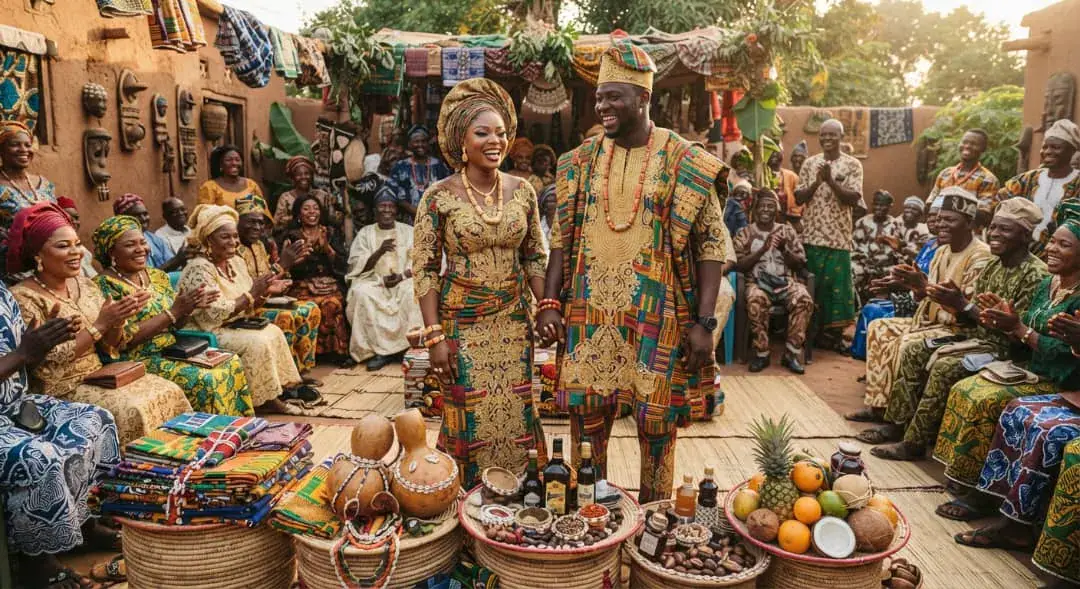
The traditional practice of dowry in Benin, known as "dot," has long been a symbol of respect and alliance between families. However, with the influence of modernity and urbanization, this practice has evolved, and its meaning has changed over time. According to Afissou Bello, a socio-anthropologist, the dowry was initially a ritual that sealed the union and respect between two families, with a strong symbolic significance.
The dowry was not originally a financial transaction, but rather a sacred ritual that signified the commitment of the man to his wife and family. The practice was deeply rooted in African culture, where marriage was not seen as a simple union between two individuals, but rather as a bond between two families, clans, or even villages. The dowry served as a symbol of recognition, respect, and security for the woman, and it also provided her with a form of capital to engage in commercial activities.
However, with the advent of modernity, urbanization, and the influence of religions, the perception of dowry has undergone a significant transformation. The urbanization has led to a change in the way dowry is celebrated, with families no longer knowing each other as they did in the past. In urban areas, the dowry has become a way to confirm the seriousness of the man, and it has also become a reflection of social status and competition.
The cost of living and the level of education have also played a significant role in shaping the modern concept of dowry. Families expect a return on investment, and the dowry has become a way to demonstrate the man's ability to provide for his wife and family. This shift in logic has led to a change in the way dowry is perceived, from a symbol of union and legitimacy to a more commercial transaction.
The role of religions in shaping the perception of dowry cannot be overstated. Different religions have varying views on dowry, with some tolerating it, others imposing it, and others rejecting it altogether. For example, in Catholic and evangelical churches, dowry is generally tolerated, but excessive demands are frowned upon. In contrast, some pentecostal pastors view dowry as a pagan practice, while others require it as a necessary part of the marriage process.
The influence of social media and the desire for social status have also contributed to the evolution of dowry in Benin. Young people are often caught between traditional expectations and modern realities, leading to a marriage system that operates at two speeds. On one hand, the law sets limits, while on the other hand, families impose their own expectations based on social status and return on investment.
The evolution of dowry in Benin highlights the complex interplay between tradition, modernity, and cultural change. As the country continues to urbanize and modernize, it is likely that the concept of dowry will continue to evolve, reflecting changing social norms and values. Ultimately, the dowry remains an important aspect of Benin's cultural heritage, and its evolution will depend on the country's ability to balance tradition with modernity.
Key points
- The dowry in Benin has shifted from a sacred alliance between families to a more mercantile logic driven by modernity and urbanization.