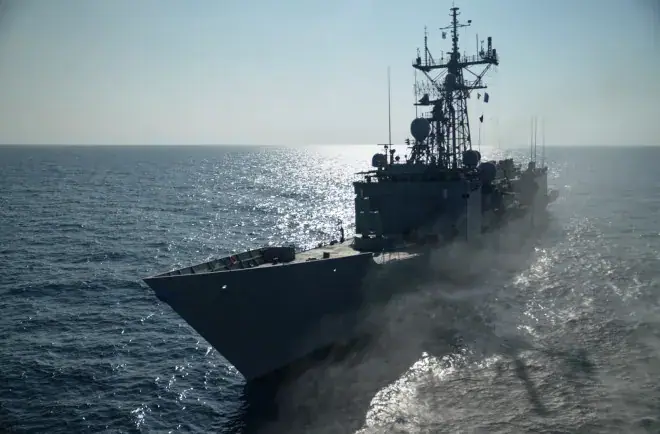
The European Union's anti-piracy mission, Operation Atalanta, is patrolling the Gulf of Aden and Somali basin to combat rising piracy. The Spanish frigate Santa Maria, flagship of the mission, recently conducted a training exercise, with Spanish special forces practicing their marksmanship skills. The exercise aimed to sharpen their kinetic skills in case they're ordered to retake vessels seized by pirates. Piracy has been on the rise in the region, with 79 pirate attacks reported since November 2023.
The Gulf of Aden is a critical waterway, with around 12% of the world's trade, including a quarter of all container traffic, passing through the Bab el-Mandeb Strait. The strait has been fiercely fought over by Saudi-backed government forces in Yemen and Houthi rebels backed by Iran. The EU's Operation Atalanta has been patrolling the region since 2008, with a multilayered anti-piracy marine force. The mission's commander, Vice Adm. Ignacio Villanueva, attributes the rise in piracy to instability in the region, saying "Instability causes instability. Instability causes illegal activities."
The ESPS Santa María, a 40-year-old and 4,000-ton warship, is leading the EU's Atalanta mission in the region. The ship is equipped with belt-fed heavy-caliber guns, artillery, torpedoes, and missiles. A helicopter and a drone regularly launch off the stern flight deck to conduct aerial surveillance and scare off would-be pirates. The ship's commanding officer, Cmdr. Fernando María Zumalacárregui Alario, emphasized the importance of the mission, saying that if the shipping lanes are threatened, "you are not going to have what you need. The prices are going to rise, and our life is going to be much worse."
The Atalanta mission has been operating in the region for over a decade, with a surveillance plane conducting aerial patrols using radar and a sophisticated inbuilt camera system. The information gathered is shared with partner military deployments from other European nations, the United States, South Korea, Japan, India, and regional powers. Portuguese Commodore José Rodrigues Pedra, the commander of the Atalanta mission at sea, noted that crisis creates crisis, and the current instability in the region is contributing to the rise in piracy.
Somali piracy is on the rise again, driven by economic malaise, rampant malnutrition, political impasse, and civil strife. Around 30% of the population faces critical levels of food insecurity, according to the U.N. Pirates based in the semiautonomous Somali region of Puntland have seized fuel tankers, and a Turkish ship carrying weapons to the Somali government was captured. The AP has tracked a resurgence in piracy, with six commercial vessels hijacked between April and August this year.
The International Maritime Organization reported that 22 seafarers remained captive on board vessels seized by pirates. Even when vessels are retaken, hostages face danger, as seen in the September operation to recover the tanker Honour 25, which had been held since April. Five crew members died during the operation, and 44 seafarers were freed from that vessel and two other tankers. Jakob Larsen, safety and security chief for the giant shipowners association BIMCO, noted that the conditions have always been there for piracy to reemerge.
The rise in piracy is also attributed to fuel prices, which have risen due to the Iran war, compelling people to search for new livelihoods. Larsen said that piracy is one such way, and the current instability in the region is creating an environment conducive to piracy. The EU's Operation Atalanta and other international efforts are working to combat piracy and ensure the safety of shipping lanes in the region.
Key points
- Piracy on the rise in Gulf of Aden due to regional instability
- EU's Operation Atalanta patrols region to combat piracy
- Economic and food insecurity contribute to resurgence of Somali piracy