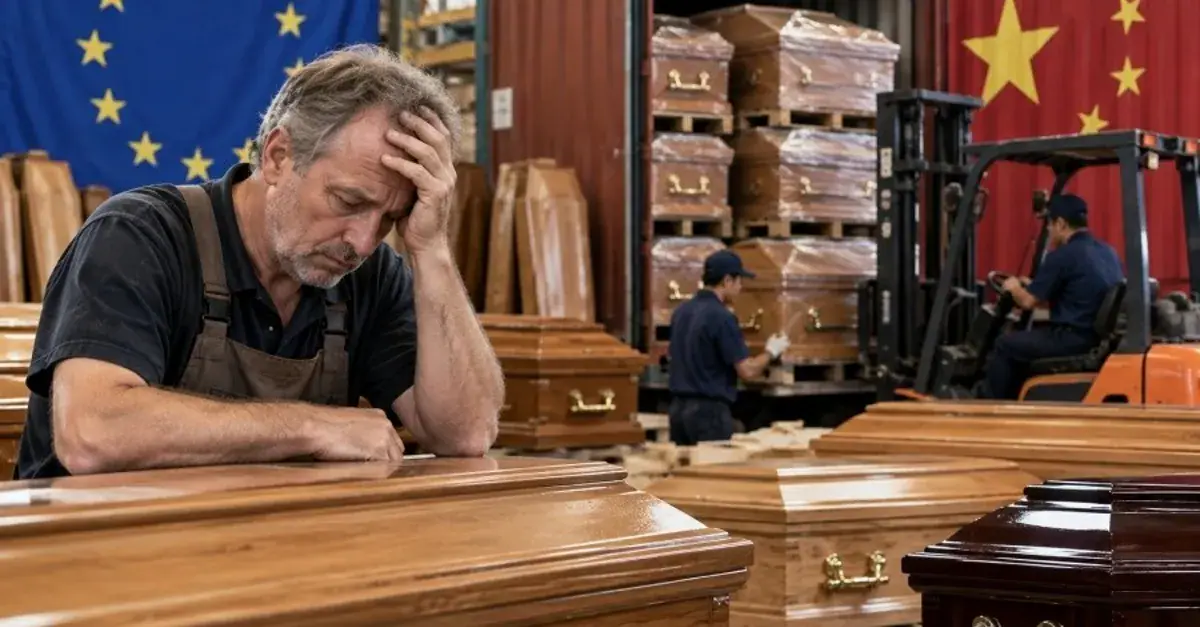
European coffin manufacturers are banding together to request the European Union investigate low-cost imports from China, warning that cheap prices and possible customs loopholes threaten an industry built around one of the continent's most crowded markets - death. The industry claims that over the past five years, about a quarter of European coffin makers have shut down, with numbers dwindling from around 120 to 90 companies.
The group, which has not yet agreed on a name, met with European Commission officials, including those from the trade department, and plans to file an anti-dumping complaint. This complaint seeks to determine if Chinese coffin makers are selling their products in Europe at unfairly low prices. Industry representatives argue that Chinese producers benefit from government support, export tax exemptions, lower labor costs, and cheaper raw materials.
A significant disparity in pricing lies at the heart of the issue, with European manufacturers estimating that producing a coffin in China costs around a third of that in Italy, even when using the same type of wood. The coalition points to several factors giving Chinese producers a competitive edge, including preferential raw material supply chains and the impact of US tariffs on Chinese goods, which may have redirected production towards Europe.
However, low prices alone do not constitute dumping under EU trade rules. To secure anti-dumping duties, European manufacturers must provide evidence that Chinese producers are selling coffins in the EU at below their normal value, that the EU industry is suffering material harm, and that the dumped imports are responsible for this harm. The coalition is gathering detailed information on production costs, raw materials, labor, and factory prices to compare equivalent coffins made in China and Europe.
This move follows a call from a group of European lawmakers to Trade Commissioner Maroš Šefčovič last year, expressing concerns about Chinese competition. The EU has already taken action against Chinese imports, imposing anti-dumping duties of 56-60% on Chinese candles in January, following an investigation into damage to the EU industry, which employs around 9,000 people in 80 companies.
The campaign by European coffin makers reflects a broader shift in trade disputes between Europe and China, with complaints about low-cost competition extending beyond strategic sectors like electric cars, steel, and chemicals to traditional manufactured goods. The industry suspects that some Chinese coffins entering the EU may not be accurately classified by customs authorities, potentially hiding the true extent of Chinese competition.
Some European coffin makers believe that certain Chinese imports may be exploiting loopholes, such as being shipped as unassembled components or mislabeled as other products. Calculations by a mathematician hired by the industry suggest that around 30,000 coffins a year may not be properly recorded in Italian import statistics, indicating a significant discrepancy that could indicate unfair trade practices.
Key points
- European coffin makers are pushing for an EU investigation into cheap Chinese imports, citing unfair competition and potential dumping.
- The industry claims that low-cost Chinese imports have led to the closure of around a quarter of European coffin makers over the past five years.
- The EU has already taken action against Chinese imports, imposing anti-dumping duties on Chinese candles in January.