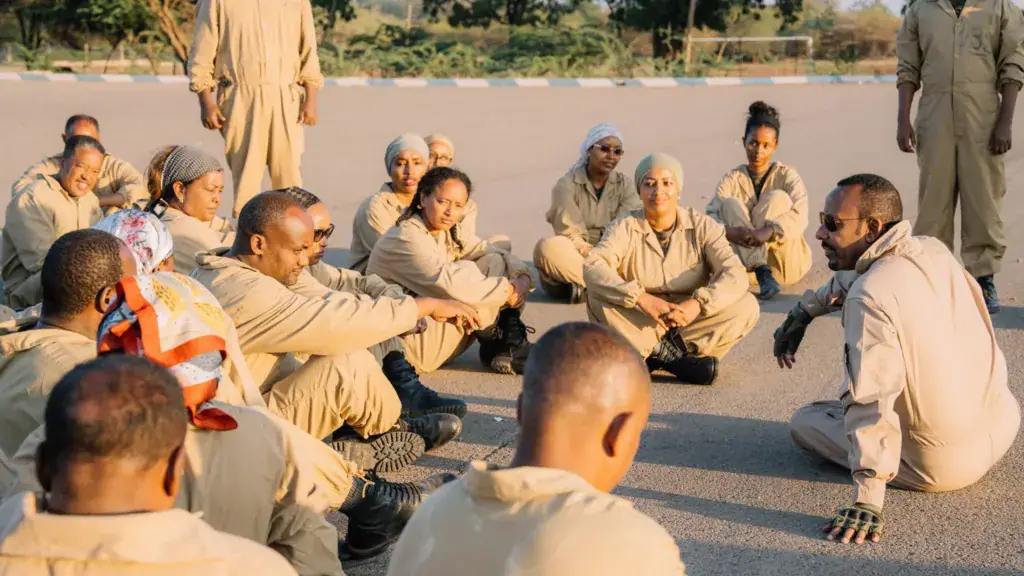
Ethiopian Prime Minister Abiy Ahmed has initiated a specialized military training program for his cabinet ministers and top administration officials. The program aims to foster more resilient leadership and accelerate national development. Images published on his official social accounts show the prime minister participating in physical exercises alongside cabinet ministers, deputy ministers, and institutional heads at the Hurso military training centre.
High-ranking leaders, including House of Federation Speaker Muferiat Kamil, Finance Minister Fitsum Assefa, and Health Minister Mekdes Daba, are participating in the training. The program involves physical exercises such as jogging, push-ups, squats, and other drills. This mandatory training is a rare occurrence in Ethiopia, where civil administrators seldom undergo military preparation.
According to Abiy, Ethiopia's ambition to achieve universal economic prosperity requires a leadership team that is physically fit, morally strong, and intellectually capable. He stressed that defense institutions impart vital lessons, including discipline, patriotism, teamwork, accountability, and leadership. Abiy noted that combining military and civilian disciplines would help foster a new generation of leaders capable of achieving both.
The prime minister argued that military-style training instills a clear sense of duty, heightened accountability, and improved collaborative skills among top executives working toward common national goals. He linked the initiative to his broader governance doctrine of building an "unbreakable nation" capable of enduring both internal and external pressures.
This initiative unfolds as Ethiopia navigates severe internal security disruptions across key territories. Armed confrontations persist in portions of the northern Tigray region, alongside ongoing fighting in Amhara and persistent instability in Oromia. Observers warn that fresh skirmishes in Tigray could spark a wider domestic conflict across the country.
Simultaneously, diplomatic relations with neighboring Eritrea remain strained. Escalating geopolitical friction between the two Horn of Africa nations has reignited fears over the possibility of a renewed military standoff. Throughout his tenure, Abiy has consistently placed military readiness and national development at the center of his government's long-term ambitions.
While supporters view the joint drills as a novel effort to boost executive efficiency and national cohesion, critics argue that militarizing the image of civilian governance risks blurring the line between civil administration and military authority during a period of heightened domestic fragility. The exact start date and total expected duration of the program have not been disclosed.
Key points
- The program aims to foster more resilient leadership and accelerate national development.
- High-ranking leaders, including cabinet ministers and institutional heads, are participating in the training.
- The initiative has sparked mixed reactions, with supporters viewing it as a novel effort to boost executive efficiency and national cohesion, while critics argue that it risks blurring the line between civil administration and military authority.