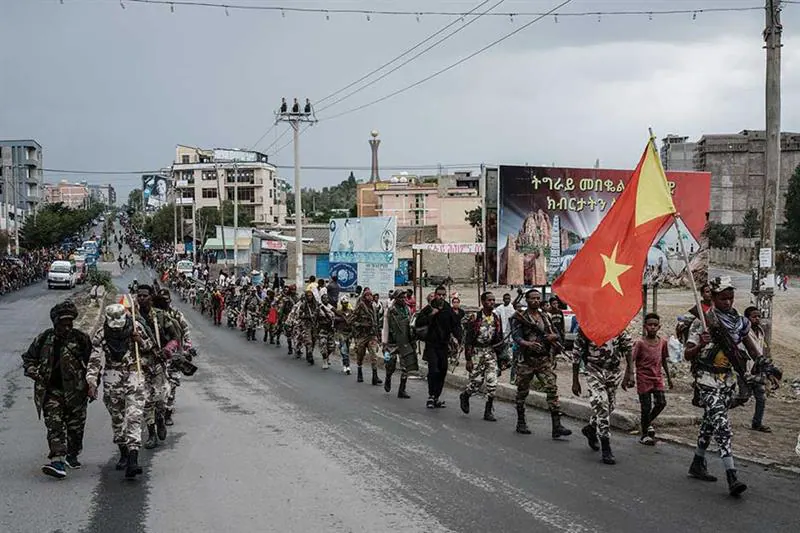
Ethiopia has plunged into a new phase of civil war, with an alliance of seven armed opposition forces formed on 20 September. The Ethiopian Peoples' Forces Coalition for Survival, known locally as Tsimdo, brings together former adversaries, testing their ability to cooperate and the stability of the authorities in Addis Ababa. This development has significant implications for the country's future and the region.
The coalition consists of the Tigray People’s Liberation Front, the Amhara Fano National Movement, the Oromo Liberation Army, the Ogaden National Liberation Front, the Afar Revolutionary National Unity Front, the Benishangul-Gumuz Liberation Movement, and the Gumuz Peoples Democratic Movement. All these factions are already engaged in fighting against the central government in Addis Ababa, headed by Abiy Ahmed. The alliance was announced by Fano leader Zemene Kase on Tigray television, whose broadcast was suspended indefinitely by the Ethiopian federal authorities.
The formation of the coalition has led to immediate consequences, with armed opposition forces in Tigray seizing the airports in Mekelle, Aksum, and Shire. The Ethiopian Airlines suspended its flights to the region due to the escalating conflict. In the Amhara region, the Tigray Defence Forces are fighting alongside Amhara Fano elements against the government, marking a significant shift in alliances.
The new alliance recalls a coalition led by the Tigray People’s Liberation Front in 1989 that brought down the regime of Colonel Mengistu Haile Mariam in 1991. However, unlike the previous coalition, the current alliance lacks a clearly defined or unified leadership. This could impact its effectiveness and the overall trajectory of the conflict.
The conflict has significant regional implications, with fighting now taking place along fronts stretching from Tigray to Amhara, Oromia, Afar, Benishangul-Gumuz, and Ogaden. This extensive spread of conflict poses a difficult challenge for the Ethiopian army, despite its superior capabilities. The involvement of various factions and regions also deprives government forces of a significant pool of recruits for mobilisation and enlistment.
The Ethiopian government has accused neighbouring countries of interfering in its affairs, including Eritrea, which has allegedly been training and supporting the Tigray Defence Forces. Sudan and Ethiopia have also traded accusations of supporting armed opposition groups in each other’s countries. These developments have heightened tensions in the region and raised concerns about the potential for further conflict.
The ongoing civil war could have significant consequences for Ethiopia's ambitions, including its quest for access to the Red Sea. Analysts believe that the war could prevent Ethiopia from launching a war against Eritrea or Somalia to secure access to the sea. However, some argue that the civil war could push Addis Ababa into waging war against Eritrea or Somalia in an attempt to secure access to the sea.
Key points
- The Ethiopian Peoples' Forces Coalition for Survival was formed on 20 September, bringing together seven armed opposition forces.
- The conflict has significant regional implications, with fighting taking place across multiple regions.
- The Ethiopian government has accused neighbouring countries of interfering in its affairs, including Eritrea and Sudan.