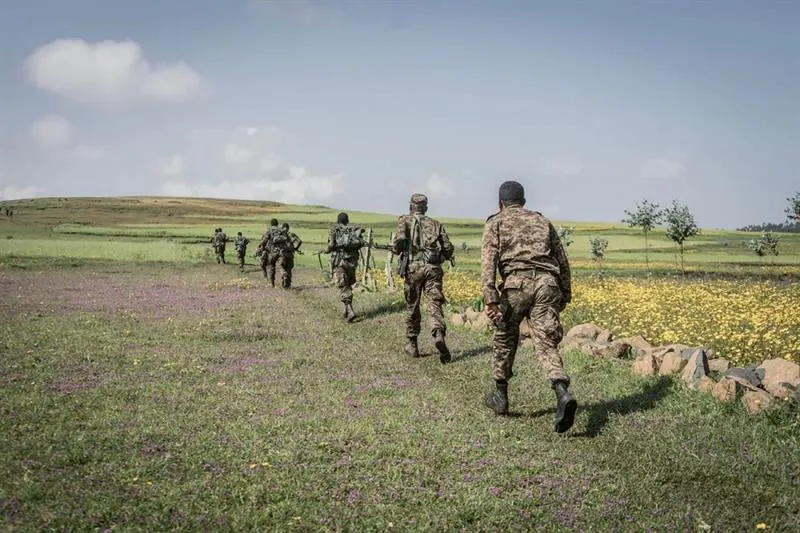
Ethiopia is planning to withdraw thousands of troops from neighboring Somalia as the country's conflict with rebel groups intensifies. According to Bloomberg, over 3,000 Ethiopian troops are expected to be redeployed from the Somali areas of Bay and Bakool in the South West State to the Tigray, Amhara, and Afar regions. The withdrawal is expected to occur in the coming days or weeks.
The decision to withdraw troops comes as fierce fighting has raged in the Tigray, Amhara, and Afar regions for the past week. The conflict has resulted in hundreds of deaths and injuries, according to health workers. The renewed clashes and drone strikes have undermined a fragile peace agreement reached in 2022. Ethiopia took a similar step during the Tigray conflict in 2020, when it withdrew thousands of troops from Somalia to participate in government military operations.
The withdrawal of Ethiopian troops from Somalia would leave a significant security gap along Ethiopia's border with Somalia. Ethiopian forces are still fighting the Al-Shabaab militant group, which is affiliated with Al-Qaeda. An Ethiopian government spokesperson did not respond to Bloomberg's questions about the fighting or the possibility of withdrawing troops. In recent days, forces linked to the Tigray People's Liberation Front (TPLF) have seized control of several towns and airports.
The military escalation in northern Ethiopia has resulted in a significant humanitarian crisis. The conflict has coincided with the formation of an alliance of seven opposition and armed groups, including Fano militia fighters in Amhara and the Oromo Liberation Army in Oromia. The alliance is seeking to overthrow Prime Minister Abiy Ahmed. Egypt, Sudan, and Eritrea have denied allegations by Ethiopian Army Chief of Staff Birhanu Jula that the three countries were supporting the rebel alliance.
Egypt's foreign ministry spokesperson, Nader Zaki, stated that Egyptian foreign policy is based on respect for the sovereignty, unity, and territorial integrity of states. Zaki added that any allegations casting doubt on Egypt's commitment to these principles are baseless. Eritrean State Minister for Foreign Affairs Hagos Ghebrehiwet told the UN General Assembly that there was a need for urgent action to stop the war and acts of sabotage.
Sudan's foreign ministry and armed forces have also rejected Ethiopia's allegations, describing them as baseless. Sudan stated that its territory has not been and will not be a launchpad for any activities targeting the security and stability of neighboring countries. Analysts warn that an expansion of the conflict into the Afar region could pose a serious threat to Addis Ababa if opposition forces manage to cut the highway linking Ethiopia to Djibouti.
The conflict in Ethiopia has significant regional implications. The Afar region borders Eritrea and Djibouti, and an expansion of the conflict could have serious consequences for the region. About 90 percent of Ethiopia's foreign trade passes through Djibouti. The international community is calling for an end to the violence and a return to peace negotiations.
Key points
- Ethiopia plans to withdraw over 3,000 troops from Somalia to combat rebel groups at home.
- The conflict in Ethiopia has resulted in hundreds of deaths and injuries.
- Egypt, Sudan, and Eritrea have denied allegations of supporting the rebel alliance.