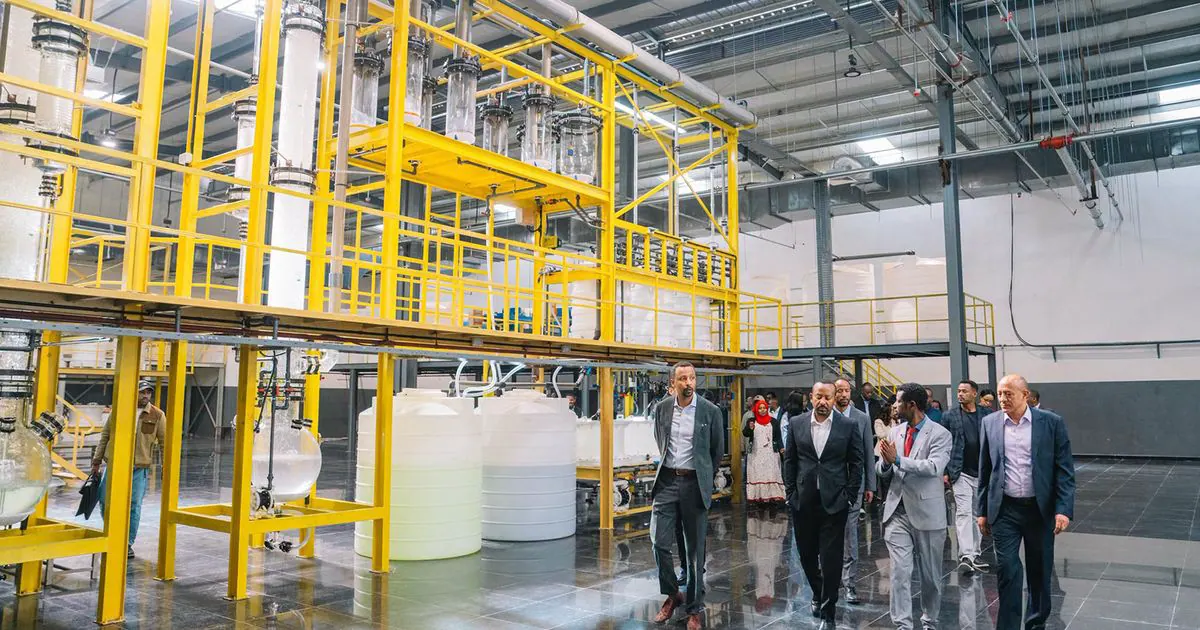
Prime Minister Abiy Ahmed officially inaugurated the National Precious Metals Refinery at the Bole Lemi Special Economic Zone. The $50 million-plus facility is a strategic partnership between Ethiopian Investment Holdings and Sam Precious Metals. It fundamentally alters the logistics of the East African trade in raw gold and silver. The plant has a capacity to process over 600 tonnes of precious metals annually. This is roughly the physical weight of 15 fully loaded Boeing 737 commercial jets.
The refinery utilizes advanced chemical and thermal laboratories to strip away impurities. It transforms raw earth into globally certified, 99.99 percent pure cast bars, commonly known as bullion. By handling this highly technical melting and minting process domestically, Ethiopia captures the full manufacturing premium on gold, silver, and other precious metals. The infrastructure provides a formal, industrial-scale buyer for local artisanal miners. They can now transition into formalized small and medium enterprises, offering them transparent international prices.
In the 2025/2026 fiscal year, Ethiopian commercial and artisanal miners produced a combined 44 tonnes of gold, generating $5.65 billion. This officially overtook coffee as the nation's primary export. The new facility's 600-tonne throughput is roughly 14 times that entire national output. Historically, only South Africa possessed this level of massive, world-class refining infrastructure on the continent. Smaller plants have recently emerged in Uganda and Ghana.
By building massive excess capacity, Addis Ababa is positioning itself as the gravitational center to absorb cross-border supplies from neighboring nations. Establishing sovereign refining capacity directly fortifies Ethiopia's macroeconomic balance sheet. It also attacks a continent-wide capital flight crisis. According to Swissaid, an estimated 435 tonnes of gold, worth approximately $30.7 billion, were smuggled out of Africa in 2022 alone.
A fully equipped, internationally certified domestic refinery allows the National Bank of Ethiopia to legally anchor the origin of its reserves. The central bank can now directly purchase pure, certified gold to stockpile as sovereign foreign exchange reserves. It can also seamlessly trade it for hard currency, creating a vital buffer to stabilize the Birr and improve the country's sovereign credit standing.
During the launch, the Prime Minister framed the facility as a mechanism to link the country's productive resources with industrial capacity. He stated that from resource extraction to industrial transformation, they are creating greater value at home. The Ministry of Mines is chasing a $6.7 billion export target for 2027. The Bole Lemi plant is the physical infrastructure required to stop the leakage, formalize the mining sector, and capture the full premium of the global gold trade.
If the refinery operates at full 600-tonne capacity with gold, the equivalent metal value would be approximately $80 billion at current gold prices. This is an indicative figure for the value of gold processed rather than a forecast of annual throughput. For decades, much of Africa's mineral wealth has been exported as raw, unpurified ore or dusty nuggets, sold at a steep discount to foreign middlemen. Refining captures that lost margin.
Key points
- The refinery has a capacity to process over 600 tonnes of precious metals annually.
- The facility is expected to help formalize artisanal miners and shore up national forex reserves.
- The launch is part of a broader strategy to position Ethiopia as a major player in the regional precious metals trade.