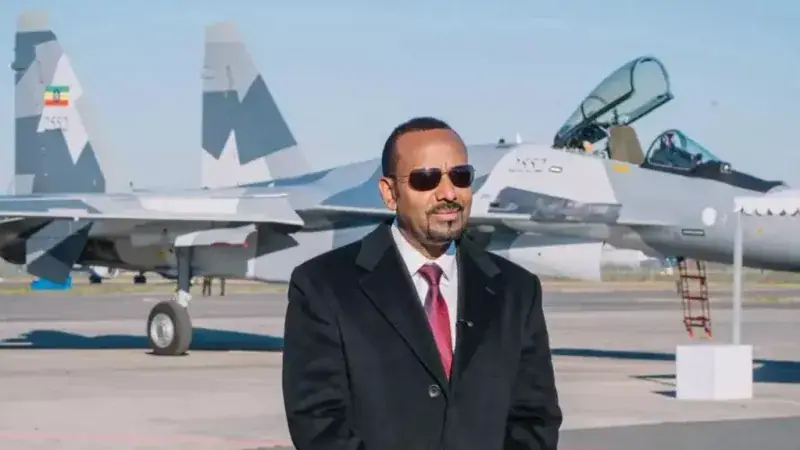
Ethiopia has taken delivery of 12 Su-35 fighter jets from Russia, a move Prime Minister Abiy Ahmed described as a "milestone" in boosting the country's defence capacity. The acquisition was made possible through an agreement between Ethiopia and Russia several years ago, with the warplanes arriving ahead of schedule. Abiy, who is attending the Russia-Africa summit in Moscow, emphasized the importance of the military hardware in protecting Ethiopia from external threats.
The Su-35 fighter jets are equipped for both air-to-air and air-to-ground combat, with the ability to detect and neutralize incoming cruise missiles at distances of up to 200 kilometers. According to Abiy, Ethiopia is the first country in sub-Saharan Africa to own this kind of "advanced combat technology." The Prime Minister stressed that building this capability is crucial for Ethiopia's survival in the region, citing the need for countries to be prepared to defend themselves.
In addition to the Su-35 fighter jets, Ethiopia has also planned to acquire four S-400 air defence systems from Moscow. Abiy described Russian President Vladimir Putin as a "close friend of Ethiopia" and highlighted the strong military ties between the two countries. Russia and Ethiopia have signed several military agreements in recent years, including a deal in 2021 to train and improve technology for the Ethiopian military.
Military intelligence analyst Qalaab Segatu told BBC Amharic that Ethiopia's acquisition of additional warplanes was a key indication that it was preparing for possible wars with other countries, not just internal conflicts. According to him, the jets are highly maneuverable and capable of covering large areas, with radars capable of ensuring air superiority and long-range scanning.
The acquisition of the Su-35 fighter jets and S-400 air defence systems is seen as a significant boost to Ethiopia's military capabilities, particularly in protecting major cities and critical infrastructure such as the Renaissance Dam. Qalaab Segatu noted that the combination of the fighter jets and air defence systems "create a significant capability to protect and defend major cities and critical infrastructure."
Abiy emphasized the importance of using drones in strengthening deterrence, in addition to the advanced capabilities of the aircraft from Russia. Ethiopia has extensively used military drones, including those sourced from Turkey and China, in recent conflicts. The Prime Minister highlighted the need to build capacity not only with drones but also with fourth-generation capabilities of the Su-30 and Su-35 aircraft.
The latest acquisition of military hardware from Russia comes amid escalating conflict in the northern Tigray region, where the government has been fighting the Tigray People's Liberation Front (TPLF). Ethiopia accuses Eritrea of backing the TPLF, which it denies. Tensions between the two countries have persisted, with Abiy terming Ethiopia's lack of direct sea access an "existential question," which Eritrea views as a direct threat to its sovereignty.
Key points
- Ethiopia receives 12 Su-35 fighter jets from Russia to boost its defence capacity
- The acquisition includes plans to obtain four S-400 air defence systems from Moscow
- The move is seen as a significant boost to Ethiopia's military capabilities amid regional tensions