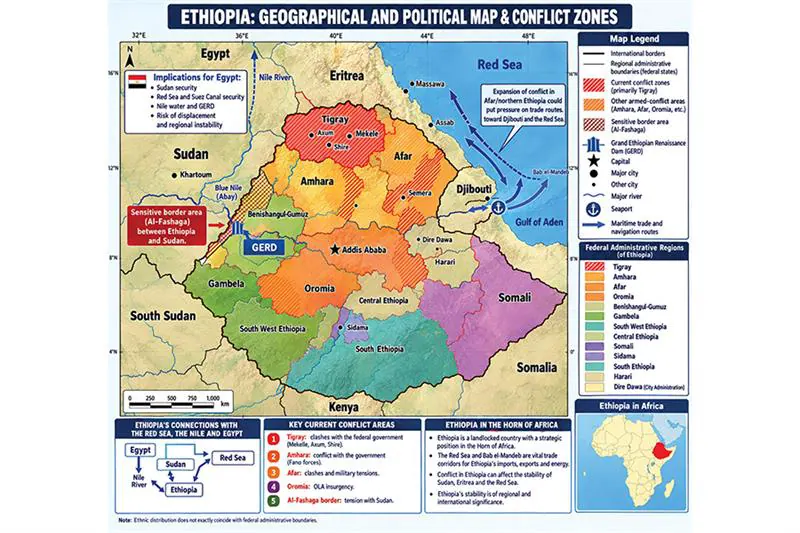
The military situation in northern Ethiopia has escalated into a complex, multi-front internal crisis. This development has significant implications for the Horn of Africa, the Red Sea, and the Sudan region. The crisis began as a limited return to tension between the federal government and the Tigray People’s Liberation Front (TPLF). However, it has evolved into a broader conflict involving various armed groups. These groups have temporarily converged to put pressure on Prime Minister Abiy Ahmed’s government.
The conflict involves the federal government led by Ahmed and the Ethiopian National Army against the TPLF and the Tigray Defence Forces in the north. The two sides fought a devastating war between 2020 and 2022, which ended with the Pretoria Agreement in November 2022. However, the agreement did not resolve the main political and security issues between them. Disagreements worsened this year, leading to the TPLF regaining influence in the region and removing the interim administration established under the peace agreement.
A significant military development occurred on 23 September when local sources reported that Tigrayan forces had taken control of Mekelle Airport, the regional capital, from the federal police. Ethiopian Airlines suspended its flights to Mekelle, Axum, and Shire due to the security situation. This event is more dangerous than a new round in the Tigray war because the opposing political and military front has broadened. Seven Ethiopian armed groups announced the formation of an alliance called the Ethiopian Peoples’ Forces Alliance for Survival on 21 September.
The alliance includes the TPLF, the Fano Movement in the Amhara region, the Oromo Liberation Army, and groups from Afar, Benishangul-Gumuz, and other areas. Notably, Fano was fighting alongside the Ethiopian government against Tigray in the 2020-2022 war but is now in the same camp as the TPLF against the federal government. Although these forces have deep historical, ethnic, and regional differences, they converge in rejecting the concentration of power at the centre and seeking to change the existing political equation in Addis Ababa.
The Oromo Liberation Army is active against the government in areas of Oromia, and its inclusion in the new alliance means the federal government may face pressure from the north and the heart of the country simultaneously. If this partnership turns into actual military coordination, the federal army’s ability to concentrate its forces in Tigray will become more difficult. However, the degree of cohesion of this alliance should not be exaggerated due to geographical distances, political disagreements, and conflicting interests.
The conflict has strategic implications, particularly in Afar, which lies between Tigray, the Red Sea, and Djibouti and is connected to Ethiopia’s trade and supply corridors. Clashes have already extended to areas in Afar, giving the conflict a strategic dimension that goes beyond the internal borders of the Tigray region. Amhara is another critical internal front, with Fano waging an armed confrontation with the federal government since 2023.
The crisis has regional implications, with Eritrea accusing the Ethiopian government of supporting armed groups opposing it. The renewed war in Tigray is taking place amid a highly tense relationship between Addis Ababa and Asmara. Sudan is also exposed to the direct repercussions of the Ethiopian crisis, given their shared border and history of tension over the Al-Fashaga area. Egypt, too, is monitoring developments in Ethiopia closely.
Key points
- The conflict in northern Ethiopia has evolved into a multi-front internal crisis with potentially profound repercussions for the Horn of Africa, Red Sea, and Sudan region.
- Seven Ethiopian armed groups have formed an alliance to overthrow Prime Minister Abiy Ahmed’s government.
- The crisis has significant regional implications, with Eritrea and Sudan exposed to the direct repercussions of the Ethiopian conflict.