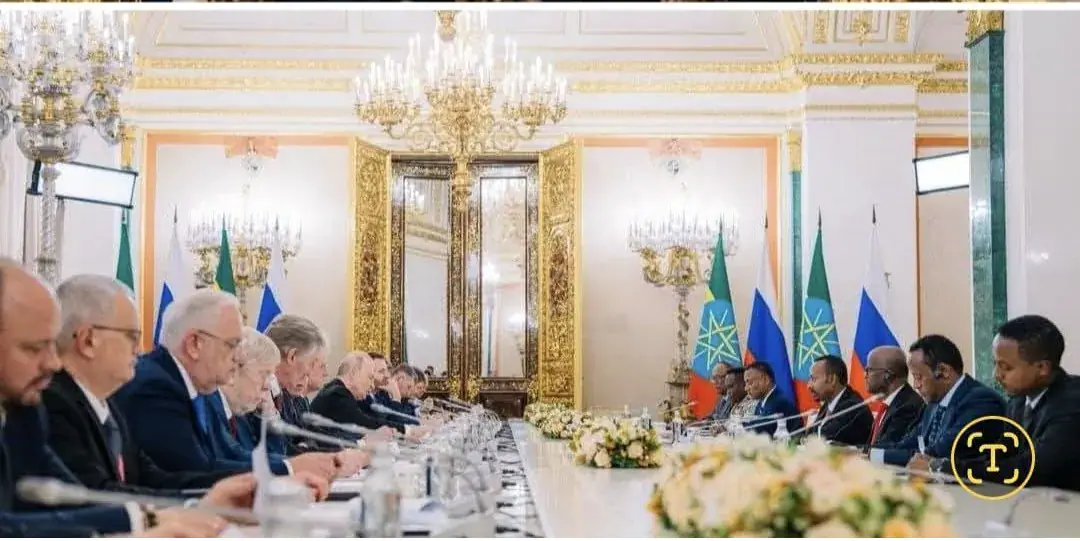
Ethiopia and Russia are poised to strengthen their longstanding diplomatic ties, established in 1898, into a strategic partnership that benefits both nations. The relationship has historically encompassed political engagement, cultural exchanges, educational cooperation, and strategic interests. As global power dynamics shift and Africa seeks a stronger voice in international affairs, both countries see an opportunity to expand cooperation in areas such as economic development, energy security, scientific innovation, and regional stability. This potential partnership could have significant implications for the Horn of Africa and beyond.
The relationship between Ethiopia and Russia has been steadily evolving, with cooperation extending across diplomacy, trade, energy, agriculture, education, science, technology, defense, and cultural affairs. For Ethiopia, engagement with Russia offers a chance to diversify international partnerships and pursue national development priorities, particularly in areas such as infrastructure development and economic growth. Russia, in turn, sees an opportunity to deepen its engagement with an influential African state and expand its cooperation across the continent. This mutual interest in strengthening ties has led to increased dialogue and cooperation between the two nations.
Economic cooperation is a key area of focus for Ethiopia-Russia relations, with bilateral trade showing significant growth in the first half of 2025. According to Ethiopia's Government Communication Service, trade between the two countries more than doubled compared to the corresponding period earlier. This growth illustrates the potential for stronger commercial engagement, with opportunities for expansion in areas such as agricultural commodities, fertilizers, industrial inputs, machinery, and other products that support economic development. However, sustainable economic relations will require more than increased trade volumes, including productive investment, technology transfer, and improved access to international markets.
Energy security is emerging as a significant area of strategic engagement between Ethiopia and Russia. Ethiopia's ambitions for industrialization, urban development, and economic transformation require a reliable, affordable, and diversified electricity supply. The country is exploring nuclear energy as a potential component of its long-term electricity system, with a major development occurring on March 31, 2026, when the Ethiopian Nuclear Energy Commission and Russia's state-owned nuclear corporation, Rosatom, signed a Strategic Roadmap for Nuclear Energy Development. This agreement establishes a framework for advancing bilateral cooperation in the peaceful development of nuclear energy.
Agriculture remains fundamental to Ethiopia's economy, food security, and employment, with cooperation with Russia potentially supporting agricultural mechanization, fertilizer supply, modern farming techniques, food processing, storage infrastructure, and agricultural research. The development of joint projects linking farmers, universities, investors, and processing industries could help improve productivity and reduce post-harvest losses. Greater investment in local processing would also enable Ethiopia to capture more value from its agricultural production. Financial and digital cooperation is another area of opportunity, with potential applications in financial technology, digital payment systems, and banking services.
Education has long provided an important bridge between Ethiopia and Russia, with Ethiopian students pursuing higher education in Russian institutions across various fields. This cooperation could be expanded to support human capital development in Ethiopia, with a focus on building local capacity and expertise in key sectors such as healthcare, engineering, and technology. By investing in education and human capital development, both countries can create a foundation for long-term cooperation and sustainable economic growth.
As Ethiopia and Russia move forward with their strategic partnership, several key areas will be critical to its success. These include the development of concrete projects that generate measurable benefits for citizens, the expansion of trade and investment, and the strengthening of cooperation in areas such as energy security, agriculture, and education. By prioritizing these areas and working together, Ethiopia and Russia can create a durable and mutually beneficial partnership that supports economic development, regional stability, and global cooperation.
Key points
- Ethiopia and Russia have signed a Strategic Roadmap for Nuclear Energy Development, marking a significant step in their cooperation on energy security.
- The two countries are exploring opportunities for cooperation in agriculture, finance, and digital transformation.
- Education and human capital development are critical areas for cooperation, with potential applications in healthcare, engineering, and technology.