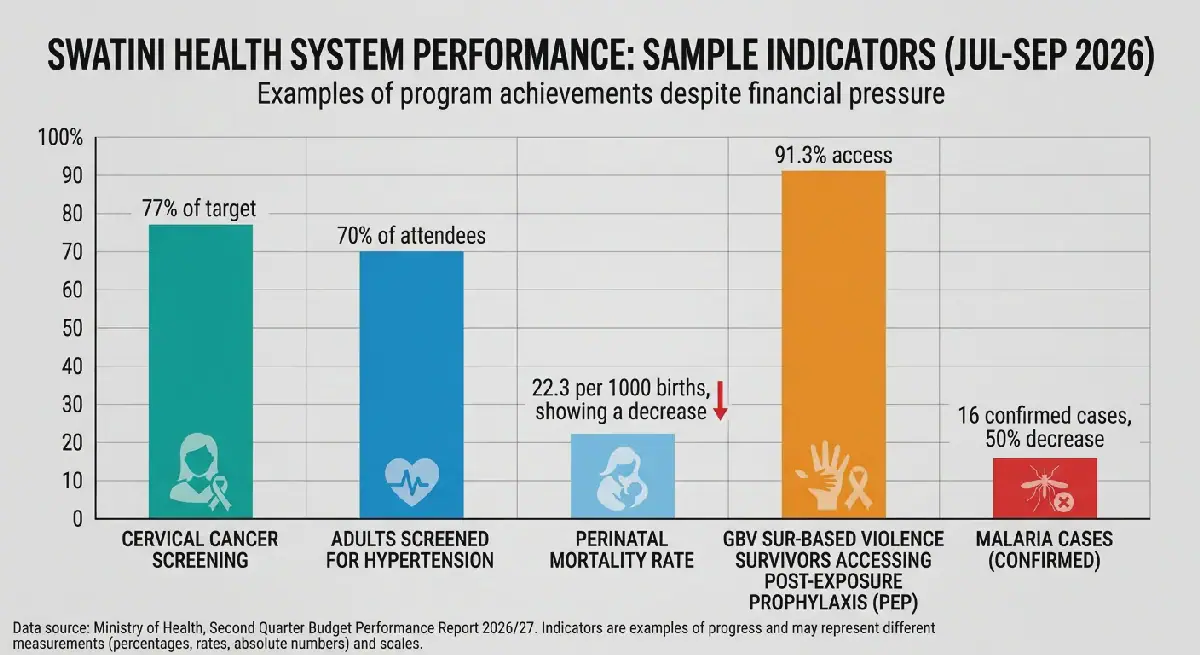
Eswatini's health system has made notable progress across several key programs in the second quarter of 2026/27, according to the Ministry of Health's Second Quarter Budget Performance Report. The report, which covers July to September 2026, highlights improvements in healthcare services despite financial pressure and the loss of donor-funded posts and services. The ministry's efforts have resulted in more women being screened for cancer and fewer mothers dying in facilities.
The Ministry of Health spent or committed E1.46 billion by 30 September, representing 48.4 per cent of its E3.02 billion annual recurrent allocation and 89 per cent of the E1.64 billion released. This spending is broadly in line with the expected half-year pace of 50 per cent, indicating that the ministry is on track at mid-year. The report also notes that institutional maternal mortality fell to 86.2 per 100 000 live births in the second quarter, down from 104 in the first quarter.
The report highlights significant reductions in maternal and perinatal mortality. Four maternal deaths were recorded in facilities, compared to six in the previous quarter, while perinatal mortality declined to 22.3 per 1 000 total births, down from 29.2 in 2023. These figures point to fewer women dying during childbirth in facilities and fewer babies dying around birth. Additionally, hospitals are handling more deliveries while recording fewer deaths.
Several hospitals have made notable improvements in healthcare services. Hlathikhulu Government Hospital recorded no maternal deaths in the quarter and cut neonatal mortality by more than half. Mankayane Government Hospital reported no maternal or neonatal deaths, while admissions rose by about 40 per cent. Hlathikhulu recorded an increase of about 75 per cent in admissions compared to the first quarter.
The report also notes significant improvements in HIV treatment and prevention. Maternal ART uptake remained above the 95 per cent global target, while the share of gender-based violence survivors accessing post-exposure prophylaxis rose from a baseline of 16 per cent to 91.3 per cent. Folic acid supplementation among pregnant women rose from 63 per cent to 89 per cent, and 92 per cent of HIV-exposed infants were tested.
Eswatini recently underwent a formal regional assessment of progress towards eliminating mother-to-child transmission of HIV, syphilis and hepatitis B. The assessment covered programme implementation, laboratory capacity, data systems and human rights and will determine readiness for evaluation by the Global Validation Advisory Committee. This assessment is a critical step towards achieving the goal of eliminating mother-to-child transmission of these diseases.
The progress made in Eswatini's health sector is a positive development, particularly given the financial constraints faced by the ministry. The report's findings suggest that the ministry's efforts to improve healthcare services are having a positive impact on the lives of citizens. Key programs, such as cancer screening and treatment for hypertension and diabetes, have shown significant improvements, and the ministry's spending is on track at mid-year.
Key points
- Eswatini's health ministry reports progress in major programs despite financial constraints.
- The ministry's spending is on track at mid-year, with E1.46 billion spent or committed by 30 September.
- Significant reductions in maternal and perinatal mortality have been recorded, with improvements in healthcare services at several hospitals.
Reporting sources
- Health spending reaches E1.46bn as key services improve · swazidailynews.com