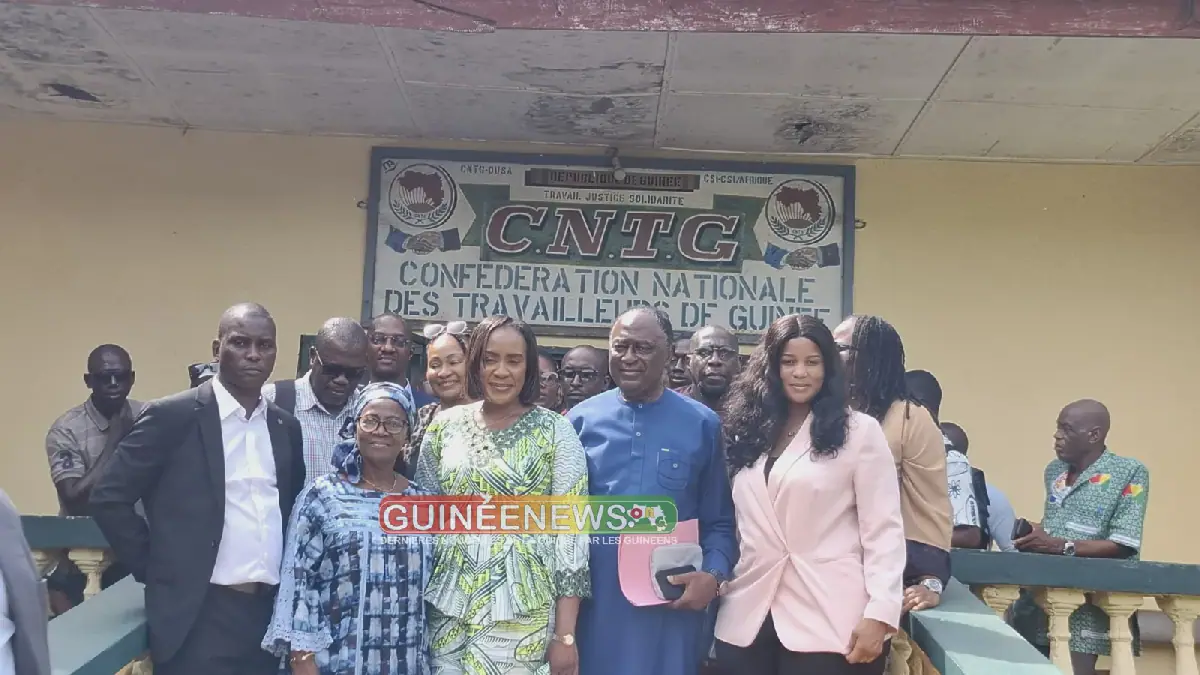
On November 10, 2026, representatives from the Guinean Movement and the Ministry of Employment, Labor, and Social Protection met at the Bourse du travail in Kaloum to discuss labor issues. The meeting was attended by Ramatoulaye Camara, Minister of Employment, Labor, and Social Protection, and Sophie Kourouma, Secretary General of the Confédération Nationale des Travailleurs de Guinée (CNTG). The discussions focused on guaranteeing decent work, extending social protection, and involving workers in the Simandou 2040 industrial program.
Sophie Kourouma emphasized the importance of decent work, citing the need for strict adherence to the Labor Code, effective implementation of collective agreements, and improved safety standards on construction sites. She also highlighted the need to extend social protection to informal economy actors and stressed that sustainable social peace can only be achieved through permanent and constructive dialogue. Kourouma also expressed the union's desire to be involved in the governance of the Simandou 2040 program.
The Simandou 2040 program was identified as a key lever for economic transformation and industrial integration. Kourouma called for a structured right to monitor labor law application, respect for workplace health, and priority for local employment. The union aims to act as a vigilant but loyal partner, providing expertise and contributing to local workforce training. Minister Camara affirmed her commitment to social dialogue, which she plans to make a systematic and permanent method of work under the Prime Minister's authority.
Minister Camara launched an appeal for cohesion and unity among union leaders, advocating for direct and preventive exchange to avoid misunderstandings. She committed to three fundamental principles: regular meetings outside of crisis periods, sincerity in addressing material or legal constraints, and rigor in monitoring operational commitments. Camara also announced the upcoming organization of a process to determine union representativeness, aiming to ensure free, transparent, and fair elections.
In response to union demands, Minister Camara confirmed her ministry's engagement to accompany efforts to integrate social partners into monitoring working conditions within the Simandou 2040 program. She detailed five priority areas for her term, including adapting training to employment for young graduates, gradually extending social protection to informal and rural workers, and strengthening labor inspection to enforce legislation.
Minister Camara's priorities also include preventive mediation of conflicts and feminization of union governance. She reaffirmed her availability and openness to all union centrals without partiality, marking the launch of a collaborative work chapter aimed at balancing economic attractivity and social justice in Guinea. The minister's engagement follows her experience in national negotiations since 2022.
The agreement between the Guinean government and union leaders aims to improve working conditions and social protection for workers. Key aspects of the pact include decent work, social protection, and involvement in the Simandou 2040 program. The collaboration is expected to promote sustainable social peace and economic growth in Guinea.
Key points
- The Guinean government and union leaders have agreed on an action plan to improve working conditions and social protection for workers.
- The plan includes decent work, social protection, and involvement in the Simandou 2040 program.
- The collaboration aims to promote sustainable social peace and economic growth in Guinea.