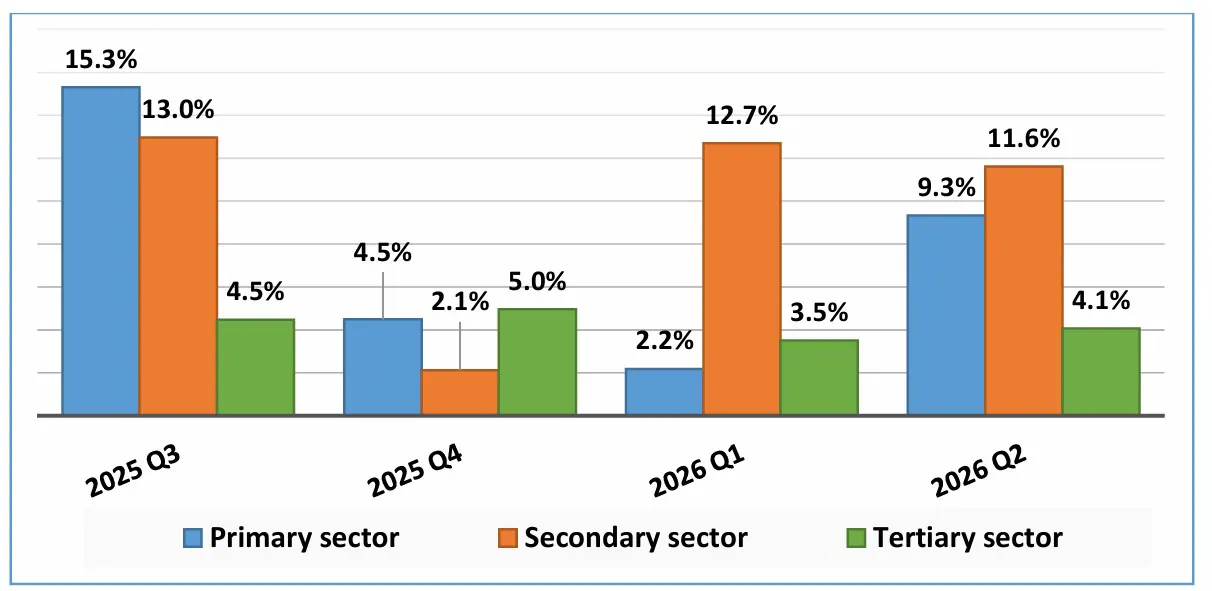
Eswatini's economy demonstrated strength during the first half of 2026, with real GDP growth accelerating from 6.1 per cent in the first quarter to 6.5 per cent in the second quarter. The Central Statistical Office reported that economic activity remained firmly in positive territory during both quarters. The first quarter recorded year-on-year growth of 6.1 per cent, up sharply from 1.1 per cent in the corresponding quarter of 2025.
The economy expanded by 1.1 per cent quarter-on-quarter in the first quarter, following virtually flat growth of 0.01 per cent in the fourth quarter of 2025. In the second quarter, year-on-year growth accelerated further to 6.5 per cent, but quarter-on-quarter momentum moderated to 0.7 per cent from the revised 2.6 per cent recorded in the first quarter. This indicates that while the economy was producing significantly more output than a year earlier, the pace of expansion between the first and second quarters slowed.
The composition of growth provides a clearer picture of the economy's performance. In constant prices, total GDP increased from E18.399 billion in the first quarter to E18.721 billion in the second quarter, while seasonally adjusted real GDP rose from E19.649 billion to E19.791 billion over the same period. At current prices, GDP increased from E22.853 billion in the first quarter to E24.044 billion in the second quarter.
The distinction between current and constant prices is important because the real GDP growth rate is designed to capture changes in economic output, while removing the effect of price changes. The CSO states that its quarterly GDP estimates are seasonally adjusted to remove fluctuations associated with factors such as weather, holidays and annual events, allowing comparisons between periods to better reflect underlying economic trends.
The first quarter's performance was heavily supported by construction and manufacturing, while the second quarter saw greater contributions from mining, manufacturing, electricity, information and communication, accommodation and professional services. At the same time, construction, finance and insurance, transport and storage, education and health and wholesale and retail trade either weakened or remained subdued during the second quarter.
Manufacturing emerged as one of the most consistent contributors to economic expansion across the two quarters. The sector grew by 12.4 per cent in the first quarter before accelerating to 14.0 per cent in the second quarter. Its contribution is particularly significant because manufacturing is one of the largest individual industries in the economy, accounting for 24.7 per cent of GDP in the first quarter and rising to 28.1 per cent in the second quarter.
The performance suggests that industrial activity remained an important source of momentum during the first half of the year. Electricity and water also strengthened substantially, growing by 11.8 per cent in the second quarter. Mining was another major source of acceleration, with growth increasing from 8.5 per cent in the first quarter to 24.3 per cent in the second quarter, making mining one of the standout performers.
Key points
- Eswatini's economy grew 6.1% in Q1 and 6.5% in Q2 of 2026.
- The economy was driven by construction, manufacturing, and mining in the first half of 2026.
- Manufacturing accounted for 24.7% and 28.1% of GDP in Q1 and Q2, respectively.