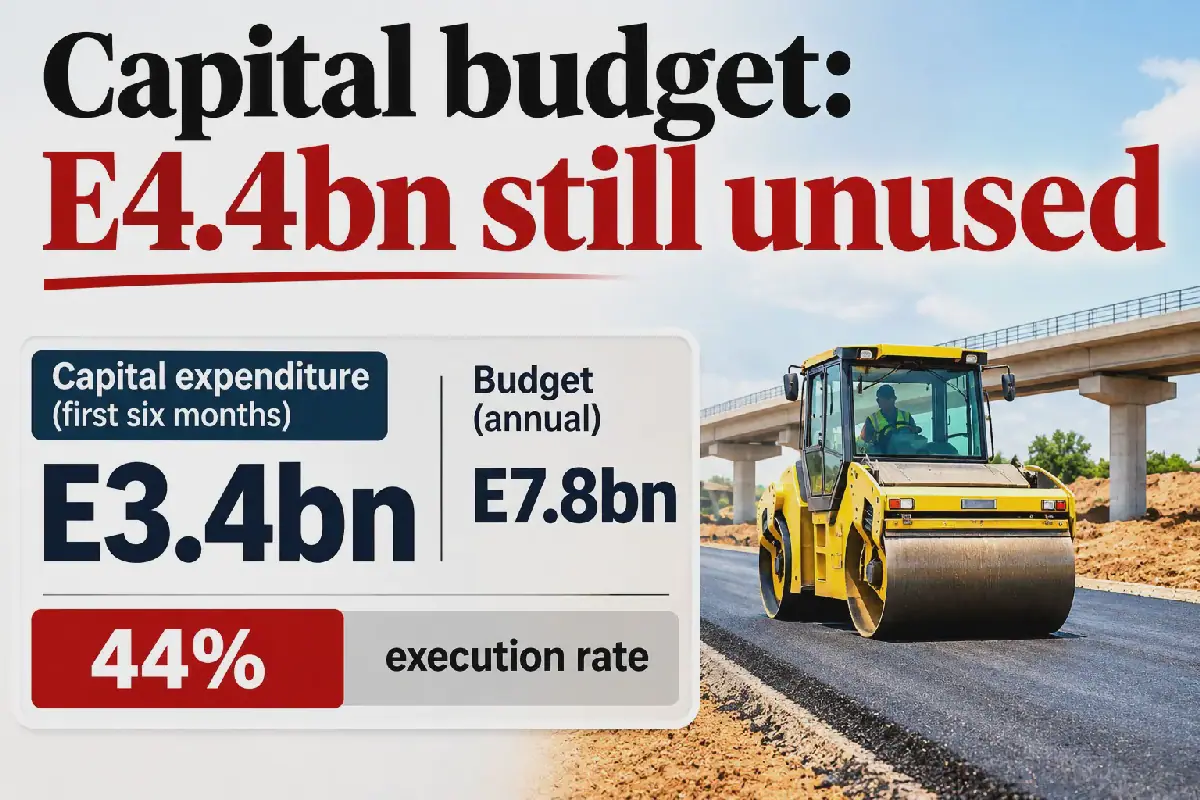
The Eswatini government had E4.4 billion remaining from its capital budget at mid-year, with project execution reaching 44 per cent, according to the Mid-Year Budget Review. Capital expenditure stood at E3.4 billion against an approved annual allocation of E7.8 billion, leaving 56 per cent of the capital budget unexecuted by the end of September. This raises questions about the pace at which the government can implement development projects during the remaining six months.
The Ministry of Finance acknowledges the need to ensure that budget allocations translate into timely project implementation and value for money. The 44 per cent execution rate represents a slight improvement from the corresponding period last year. The government attributes the improvement to gradual acceleration in project implementation and strengthened monitoring of infrastructure expenditure.
The Ministry of Finance expects capital expenditure to accelerate during the third and fourth quarters, citing historical expenditure patterns that show implementation of capital projects generally gains momentum during the latter half of the financial year. To achieve this, the government will need to execute a substantial proportion of its remaining development budget before the financial year closes.
The review also identifies tight cash flow conditions as a challenge affecting expenditure management across government. Line ministries face increased spending pressures despite efforts to maintain financial discipline. The government's medium-term outlook points to a different trend in capital expenditure, projecting a decline of 5.2 per cent over the medium term.
The anticipated reduction in capital expenditure is linked to the expected completion of major infrastructure projects, including the Mkhondvo-Ngwavuma Water Augmentation Project and the MR14 road infrastructure project. Several energy projects are expected to be completed by the 2027/28 financial year, which will strengthen domestic electricity generation and reduce dependence on imported power.
Eswatini's economy is expected to grow more slowly in 2026, with economic growth projected at 3.7 per cent, down from 4.9 per cent in 2025. The slowdown comes as unemployment remains at 33.5 per cent nationally and 52.2 per cent among the youth. The figures highlight the continuing challenge of translating economic expansion into employment opportunities.
The Ministry of Finance identifies private-sector employment, improved access to finance, and support for micro, small and medium-sized enterprises as priorities to address unemployment. The government also recognises the need to reduce skills mismatches and improve education, health, and social protection to ensure that economic expansion translates into better living standards.
Key points
- E4.4 billion of Eswatini's capital budget remains unused at mid-year.
- The government's capital expenditure execution rate stands at 44 per cent.
- Eswatini's economy is expected to grow at 3.7 per cent in 2026, down from 4.9 per cent in 2025.
Reporting sources
- E4.4bn capital budget still unused · Times of Swaziland