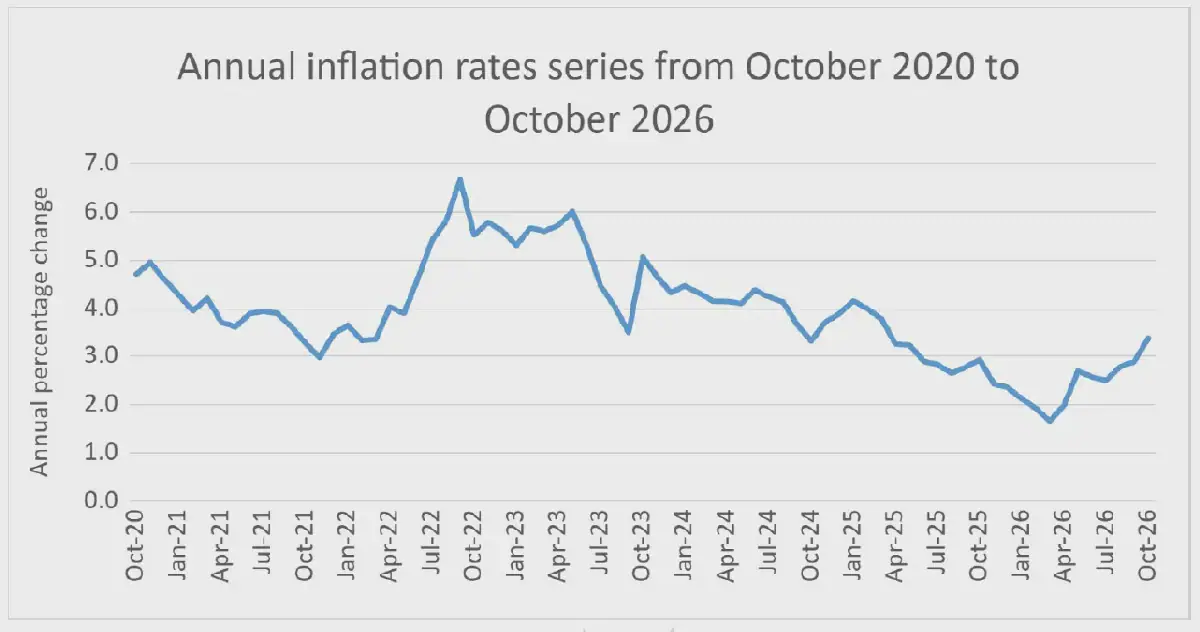
Eswatini's headline inflation rate accelerated sharply in October 2026, climbing by 0.5 percentage points to 3.4 per cent from the 2.9 per cent recorded in September. This was primarily driven by surging fuel prices and elevated utility costs. According to the October 2026 Consumer Price Index (CPI) Report released by the Central Statistical Office (CSO) within the Ministry of Economic Planning and Development, the latest print marks the highest annual inflation rate recorded in the Kingdom since February 2025.
The CSO report reveals that the upward trajectory in the headline figure was heavily anchored by two major expenditure categories: housing and utilities, and transport. Together, these two baskets accounted for 3.0 percentage points of the overall 3.4 per cent annual inflation rate. Housing, water, electricity, gas and other fuels recorded an annual inflation rate of 6.8 per cent and contributed 1.9 percentage points to the headline figure. Within this group, liquid fuels surged by 54.2 per cent year-on-year and 13.7 per cent month-on-month.
Transport inflation jumped dramatically from 0.9 per cent in October 2025 to 6.9 per cent in October 2026, contributing 1.1 percentage points to headline inflation. This surge was propelled by fuels and lubricants for personal transport equipment, which spiked by 41.6 per cent year-on-year and 13.2 per cent month-on-month, alongside a 27.9 per cent annual increase in passenger air transport. Education also recorded an annual inflation rate of 3.4 per cent, led by pre-primary and primary education and tertiary education.
In contrast, the Food and Non-Alcoholic Beverages category remained largely subdued, recording a marginal annual deflation of -0.1 per cent. Modest annual price declines in staples such as bread and cereals, sugar and confectionery, and fruit helped offset increases in fish and seafood, oils and fats, and non-alcoholic beverages. Without the moderating effect of food prices, underlying inflation stood notably higher; the CSO’s analytical series shows that CPI excluding food and non-alcoholic beverages reached 4.3 per cent year-on-year.
A closer look at the CSO’s analytical breakdown underscores the impact of regulated tariffs and energy adjustments on the broader economy. Inflation for administered prices surged to 11.0 per cent year-on-year, starkly outpacing non-administered prices, which rose by just 1.4 per cent annually. Goods inflation stood at 4.0 per cent in October 2026, while services inflation remained comparatively contained at 2.4 per cent.
The October inflation jump breaches the 3.0 per cent threshold after headline inflation had remained below 3.0 per cent throughout the earlier months of 2026. The print arrives ahead of the Central Bank of Eswatini’s (CBE) upcoming Monetary Policy Committee (MPC) deliberations. In late September, the CBE raised its benchmark repo rate by 25 basis points to 7.0 per cent amid warning signs over global oil prices and supply-side pressures.
The rising inflation rate poses challenges for households and businesses in Eswatini. With fuel and utility costs continuing to drive inflation, it remains to be seen how the CBE will respond to these pressures in its upcoming MPC meeting. The impact of the inflation rate on the economy and the livelihoods of Eswatini's citizens will be closely watched in the coming months.
Key points
- The inflation rate was driven primarily by surging fuel prices and elevated utility costs.
- The Central Statistical Office reported that the inflation rate for administered prices surged to 11.0 per cent year-on-year.
- The Central Bank of Eswatini raised its benchmark repo rate by 25 basis points to 7.0 per cent in late September.
Reporting sources
- Fuel, utilities push inflation up to 3.4% · Times of Swaziland