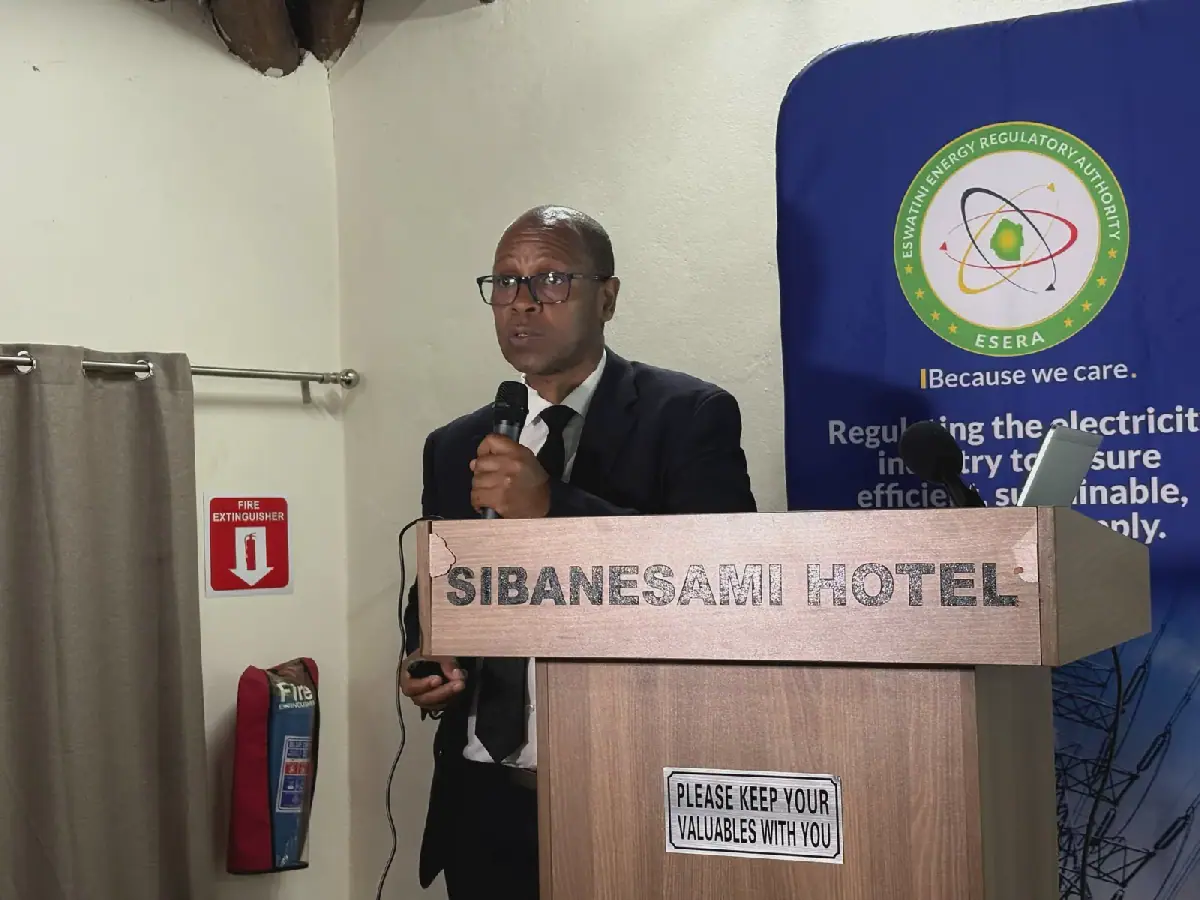
Eswatini Energy Regulatory Authority (ESERA) Chief Executive Officer Sikhumbuzo Tsabedze has addressed public scepticism about tariff consultations, stating that the regulator takes consumer input seriously and that Eswatini Electricity Company (EEC) has not received everything it has requested. Speaking at a public consultation, Tsabedze presented ESERA's record of applications versus awards to demonstrate the regulator's decisions are based on technical verification and stakeholder submissions.
The public consultation was convened to discuss EEC's three linked applications, including a multi-year price determination filed on 30 October, restructuring of time-of-use tariffs, and a revised feed-in tariff for embedded generation. EEC is requesting an average increase of 18.38 per cent for 2027/28 and 14.68 per cent for 2028/29. Tsabedze stressed that these figures are averages and the impact will differ by customer category.
If approved as applied for, the average tariff would increase from E2.98 per unit to E3.67 per unit in 2027/28, and to E4.02 per unit in 2028/29. The increases would take effect on 1 April 2027 and 1 April 2028 respectively. Tsabedze emphasized that no determination has been made and the purpose of the consultation is to collect input that will form part of ESERA's final analysis.
Tsabedze pointed to the history of tariff decisions, showing that ESERA does not simply approve EEC's requests. He noted that in each cycle, the award has been lower than the application, partly due to economic and technical analysis, and partly due to public input. In the previous cycle, ESERA awarded an increase of 14.7 per cent, which was later reduced to 11.7 per cent by the government.
The reduction was made with a commitment to provide a shareholder contribution to EEC to cover part of the gap. Tsabedze mentioned that an interim tariff review was later required after the Eskom supply agreement and another supply contract came to an end. EEC filed an interim application to deal with the new costs, part of which relates to the current under-recovery.
Tsabedze described the regulator's role as balancing interests, ensuring the economy cannot progress if the utility collapses, and consumers cannot survive if they are overcharged. He emphasized that finding this balance is difficult and depends on contributions from all stakeholders.
The consultation is part of ESERA's efforts to engage with the public and consider their input in tariff decisions. The regulator's decisions are shaped by technical verification, consumer submissions, and other stakeholder input.
Key points
- ESERA's decisions are based on technical verification and stakeholder submissions.
- EEC's tariff requests are not automatically approved by ESERA.
- The regulator aims to balance the interests of the economy and consumers.
Reporting sources
- ESERA listens to consumers, does not rubber-stamp EEC requests – ESERA · swazidailynews.com