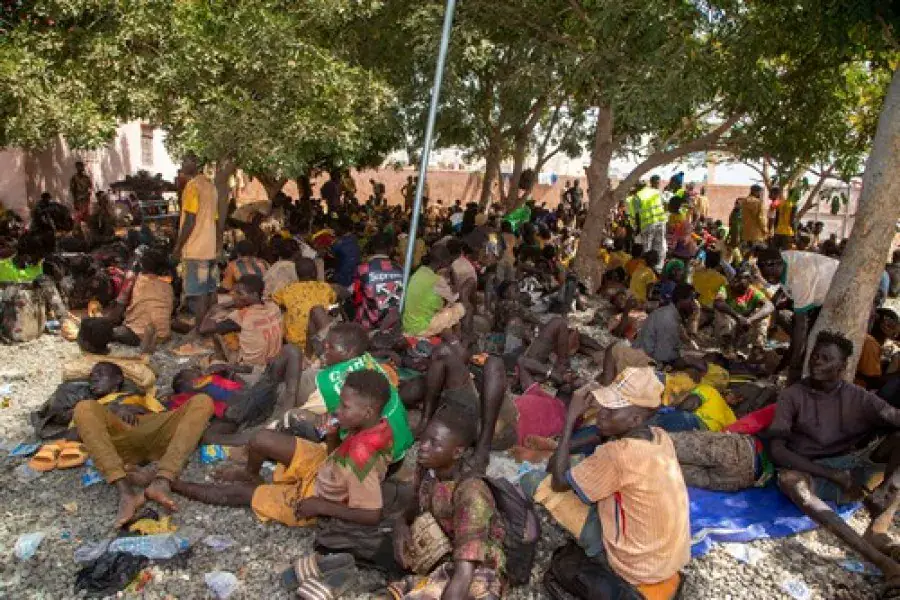
The recent repatriation of thousands of young Burkinabè working in gold mining sites in Guinea has sparked a reflection beyond its humanitarian dimension. Mali's solidarity in facilitating their return to Burkina Faso showcases the depth of cooperation between Alliance des États du Sahel (AES) countries. However, a crucial question arises: what to do with these young people once they are back home? Expert Hamadoun Ousmane Bocoum suggests turning their return into an opportunity for job and wealth creation.
These young individuals have often acquired practical skills in mining, mechanics, transportation, commerce, and logistics. This human capital deserves to be valued. Bocoum proposes five avenues: identifying and valorizing their skills through a census of experiences and qualifications; orienting them towards productive sectors like agriculture, livestock, agro-industry, construction, mechanics, and services; facilitating access to financing through a mechanism involving the state, banks, microfinance institutions, and development partners.
Bocoum's proposals could be part of a National Program for the Economic Reintegration of Repatriated Youth, which could also constitute an economic cooperation initiative within the AES. The success of this operation will not only be measured by the number of young people repatriated but also by the number of those who have found productive activities and future prospects in their country. This approach aims to shift from humanitarian solidarity to economic solidarity.
Mali's economic challenges are also reflected in its gold extraction industry. The country exports gold, but it is often refined and transformed elsewhere. For example, the Swiss refine and transform gold into high-value products, generating significant added value. Mali's Minister of Mines mentions 2,750 billion FCFA in gold exports and 888.5 billion FCFA paid to the state, but notes that the country still lacks a large refinery, an international-level school of jewelry making, and a recognized certification laboratory.
To address these challenges, Mali could leverage its gold resources to develop its economy. The country has discussed transforming lithium locally and plans to establish an École des Mines et du Pétrole. However, compared to Switzerland or Dubai, Mali still needs to develop several key sectors, including a large refinery, a school of jewelry making, and a regional gold trading center.
With 18.4 billion FCFA from the Fonds de Développement des Mines et de la Géologie (FMDL), Mali could finance initiatives to develop its gold industry. This amount could support an institute of excellence in jewelry making and jewelry, workshops, and partnerships with countries like Switzerland, the UAE, Italy, or France. The goal is to train hundreds of artisans, designers, and experts in precious metals to generate more value than simply redistributing operating funds.
The real challenge for Mali is no longer just producing more gold but moving up the value chain to become a country that extracts, refines, transforms, certifies, and exports finished products with high added value. This would allow Mali to capture a much larger share of the wealth created by its mining resources. By transforming the return of young Burkinabè gold miners into economic opportunities, Mali can create jobs, stimulate economic growth, and develop its gold industry.
Key points
- Expert Hamadoun Ousmane Bocoum proposes turning the return of young Burkinabè gold miners into job and wealth creation opportunities.
- Mali aims to develop its gold industry by moving up the value chain and capturing a larger share of the wealth created by its mining resources.
- The country plans to use 18.4 billion FCFA to support initiatives that develop its gold industry and train artisans and experts in precious metals.