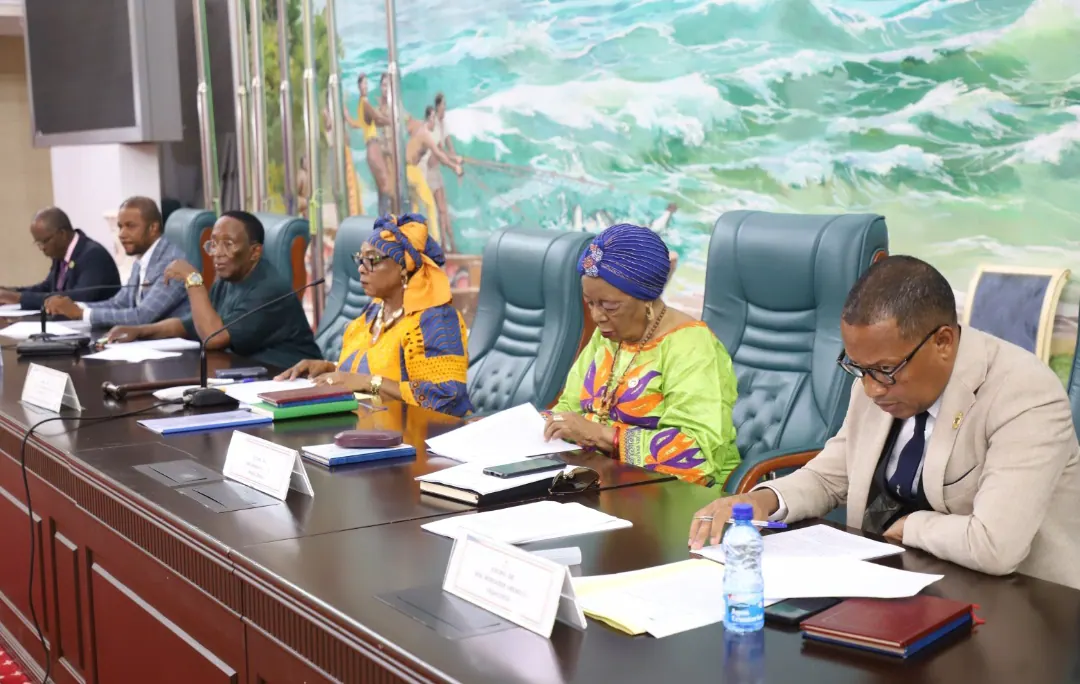
The Senate commission of Equatorial Guinea has concluded its review of the new Press Freedom Law and Journalism Practice, approving the final report and text by consensus. The commission's work was moderated by Senate President Efua Asangono. The commission's conclusion follows a meeting with a government delegation led by Information, Press, Culture, and Tourism Minister Juan José Ekuna Esono Mangue. Senators raised and resolved various questions related to the law's implementation.
During the review process, senators addressed several key issues, including the integration of media and professionals working in digital environments, the delineation of competencies with the Telecommunications Regulatory Body (ORTEL), and professional guarantees for journalists. The new law aims to adapt to the digital era, providing clearer definitions and protections for journalists working in digital and audiovisual media. The law also reinforces professional guarantees, particularly regarding professional secrecy and source protection.
The approved text incorporates significant changes to adapt journalism to new forms of communication and reinforce information professionals' guarantees. One of the main focuses is adjusting to the digital era through a more precise definition of the law's scope. The project ensures that professionals working in digital and audiovisual media have the same protections and are subject to corresponding deontological duties. The law does not regulate the audiovisual business market.
The new law establishes the right to access public information as a cornerstone of administrative transparency. This right is structured through defined deadlines, specific exceptions, and appeal mechanisms. The proposal seeks to establish a formal framework for public administration information requests, determining access conditions and situations where this right may be limited. This move aims to promote transparency and accountability in public administration.
The law clarifies the division of competencies between the Ministry of Information and ORTEL. The Ministry of Information will handle editorial and deontological issues, while ORTEL maintains technical competencies related to radioelectric spectrum management, in accordance with telecommunications legislation. This clear division of responsibilities aims to prevent conflicts and ensure effective regulation.
The proposed law also includes the creation of a Journalists' College in Equatorial Guinea, conceived as a public law corporation with functional autonomy. According to the approved text, the College will play a significant role in promoting journalism standards and protecting journalists' rights. The Journalists' College is expected to contribute to the development of a free and independent press in the country.
The new Press Freedom Law and Journalism Practice is set to be presented to the Senate plenary session, marking a significant step towards its approval. If passed, the law will provide a comprehensive framework for press freedom and journalism in Equatorial Guinea, adapting to the challenges of the digital era and reinforcing professional guarantees for journalists. The law's implementation will be closely watched by stakeholders and the general public.
Key points
- The new law aims to adapt to the digital era, providing clearer definitions and protections for journalists working in digital and audiovisual media.
- The law establishes the right to access public information as a cornerstone of administrative transparency.
- The Journalists' College will be created as a public law corporation with functional autonomy to promote journalism standards and protect journalists' rights.