The Emirati production Jasmine’s Fingers is currently being staged at the Cairo Hanager Theatre as part of the 4th Eazees International Women’s Theatre Festival, which runs from 25 September to 2 October. This intimate story of love and deception unfolds into a meditation on illusion, physical appearance, and the scars left by violence. The play, originally penned by Iraqi playwright Ahmed Al-Majed, was first staged at the 7th Dubai Youth Theatre Festival in 2013.
The 2026 production features mise-en-scène by Emirati director Elham Mohammed and stars Ahmed Abu Arada and Khadija Al-Bakoush. Mohammed handles the text with measured theatrical language, trusting its psychological tensions rather than overloading them with visual effects. The dramatic structure moves between two parallel timelines: the present wedding night and a retrospective narrative that gradually uncovers past secrets, sacrifices, and betrayals.
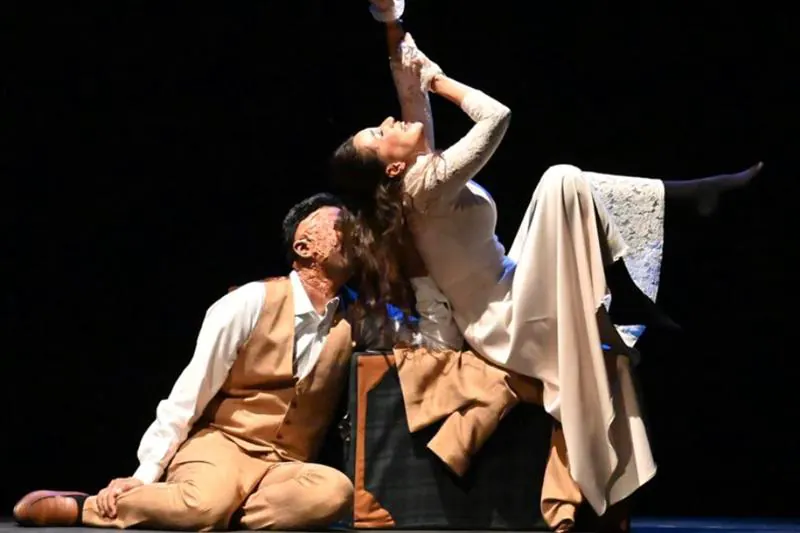
The play revolves around a couple’s seemingly intimate encounter, which gradually reveals the unease and emotional distance beneath. The female protagonist, a woman approaching her 40s, burdened by societal pressure and a desperate longing for security, has been wooed by a man through poetry and romantic correspondence. However, on their wedding night, she encounters a man wrapped in shadow, his right hand motionless as if paralyzed, his face severely disfigured by a past bombing.
The play belongs to a broader theatrical tradition in which words become the architecture of an imagined beloved. The title itself operates on a rich metaphorical plane, with “Jasmine” evoking beauty, tenderness, and fragile hope, while “fingers” suggest external forces that touch, shape, and ultimately damage human lives. The play interrogates how much of romantic love is directed toward an actual human being versus a projection we manufacture from words, letters, and longing.
Elham Mohammed’s mise-en-scène uses spatial isolation, spotlights, shadow, and stage fog to shape an atmosphere of uncertainty, blurring the boundaries between memory, imagination, and the present moment. The two performers, Ahmed Abu Arada and Khadija Al-Bakoush, must sustain this sparse theatrical world, and both rise to the challenge with palpable commitment. They fill the minimalist space with tension, using their bodies and voices to give physical form to the play’s psychological conflicts.
The performance is accompanied by light Western music, which, while attempting to mirror the ebb and flow of the characters’ emotions, gives the production a more contemporary and international sonic language. However, the continuous presence of the background score sometimes works against the dramatic tension. Khadija Al-Bakoush delivers a visceral portrayal of the bride, while Ahmed Abu Arada adopts an internalized posture as the husband.
The Khorfakkan Arts Theatre, one of the most vibrant regional troupes in the Emirate of Sharjah, has brought a haunting, intensely psychological theatrical experience to Cairo. The theatre dates back to its 1988 launch as Al-Tali'ah (Avant-garde) Theatre in Khorfakkan before officially taking its current name in 1996. This production demonstrates that Al-Majed’s text reaches well beyond a localized political allegory, inviting multiple readings and exploring broader questions of identity, perception, and human psychology.
Key points
- The play explores the tension between text and flesh, and how we construct people in our imagination through words.
- The production features a sparse set centred on a single prop: a suitcase, which shifts function throughout the performance.
- The play interrogates how much of romantic love is directed toward an actual human being versus a projection we manufacture from words, letters, and longing.