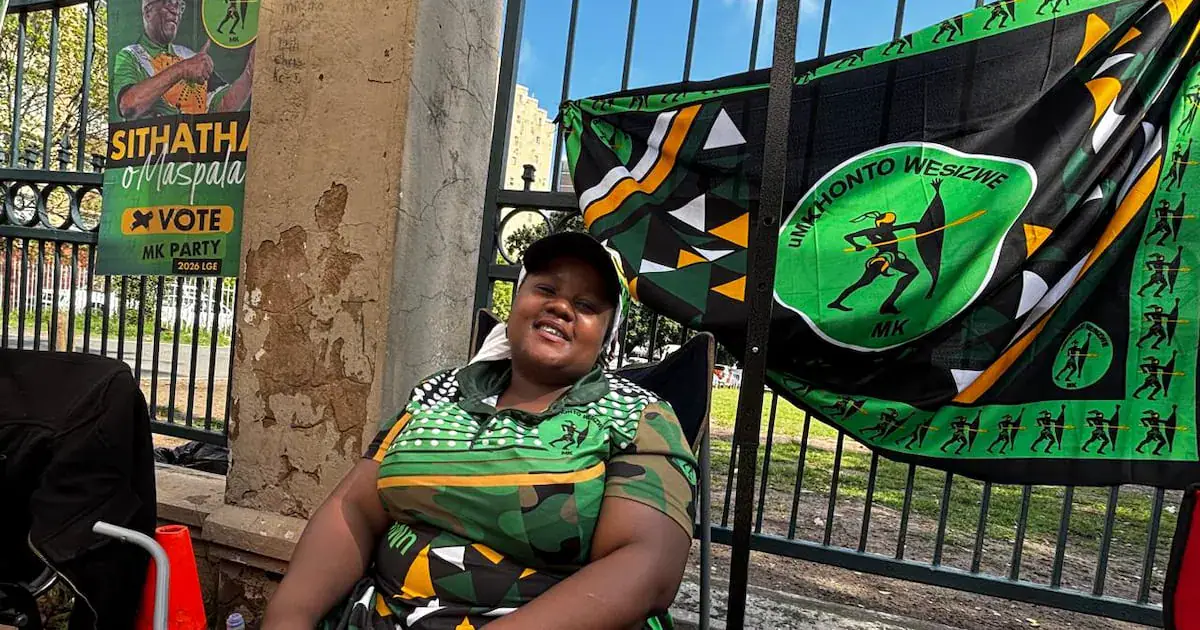
In the vibrant city of Durban, supporters of various political parties took to the streets, showcasing their enthusiasm for the local government elections. A flash mob of MK Party supporters sang and danced down Diakonia Avenue, while a group of ANC-clad supporters waved the party's flag and sang to drum up support. The excitement was palpable as voters waited patiently in snaking queues to cast their ballots at voting stations set up at the Durban Music Centre and YMCA Park.
Voters expressed their determination to bring about change in the volatile economic hub, which has been plagued by crime, water crises, and xenophobic civil unrest. Pearl Mbatha, a 34-year-old resident of Durban's CBD, joined the voting queue at 6am, saying her vote was a priority and that she wanted to make a difference. She expressed her dissatisfaction with the current ruling party, stating that her vote would help bring about change.
MK Party supporters were optimistic about their chances of winning the elections. Ongeziwe Sithole, a 32-year-old supporter, was confident that the party, formed in 2023 by former president Jacob Zuma, was ready to rule the metro. He celebrated and counted down the hours until the results were announced, saying that the party's time was near. The need for change and to oust the ruling party was a common theme among voters.
DA eThekwini mayoral candidate Haniff Hoosen was confident that the Blue Brigade would emerge victorious. After casting his vote at Glenview Primary School in Chatsworth, Hoosen said his confidence came from conversations with voters during the campaign. He expressed concern about the possibility of violent conflict if the MK Party rejected the election results.
An eNCA MarkData poll put the MK Party ahead in eThekwini at 48.0%, followed by the DA at 25.2% and the ANC at 14.5%. Hoosen framed the contest as a choice between an MK Party government and a DA government, saying that voters would determine who governed the city. He emphasized that polls were just opinions and that the voters' decision was what mattered.
Police identified 124 high-risk voting stations in eThekwini and 165 across KwaZulu-Natal. Despite this, the army was not visible at many polling stations in the metro. Hoosen criticized the reliance on water tankers, saying that elderly people should not have to carry buckets of water for hundreds of meters to their homes. He vowed to restore water to residents' taps if elected.
Other mayoral candidates, including Mxolisi Phakathi of the MK Party and Mkhuleko Hlengwa of the IFP, expressed their confidence in winning the elections. Phakathi encountered some drama when he was blocked from entering a polling station wearing party regalia, but was eventually allowed to cast his vote. Hlengwa described the elections as the most consequential polls since the dawn of democracy, saying that it was a "do-or-die" moment for voters.
Key points
- The MK Party is ahead in eThekwini according to an eNCA MarkData poll, with 48.0% of the vote.
- Voters in eThekwini are seeking change, citing crime, water crises, and xenophobic civil unrest as major concerns.
- The local government elections in eThekwini are seen as a crucial moment for the city's future, with many voters eager for a change in leadership.