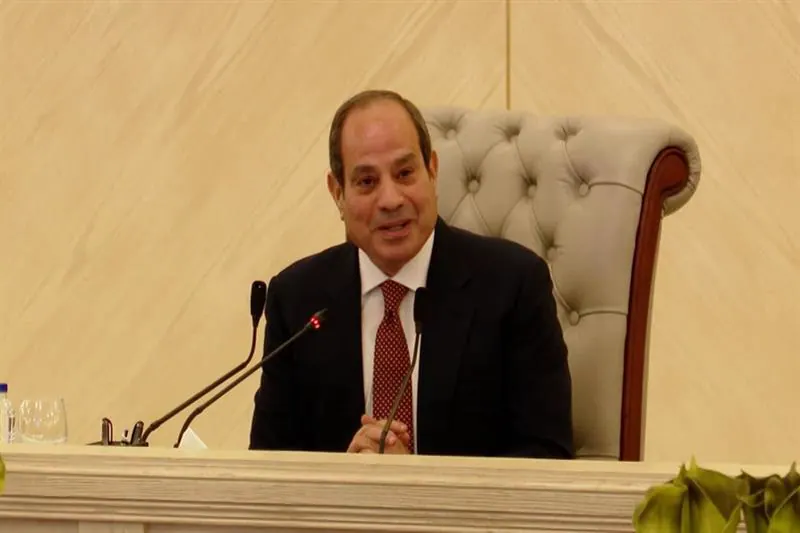
Egyptian President Abdel-Fattah El-Sisi on Tuesday stressed that protecting Egypt requires national unity, public awareness, and better government performance. He made these remarks during a meeting at the Strategic Command headquarters in the New Capital with Prime Minister Mostafa Madbouly, cabinet ministers, governors, senior officials, military and police commanders, village mayors, and community leaders. El-Sisi outlined the economic costs of regional conflict and reaffirmed Egypt's foreign-policy positions.
El-Sisi emphasized that the state's principal objective is to preserve Egypt and mobilize every available resource to protect the country and confront its challenges. He noted that all countries face difficulties, and their ability to overcome them depends on their policies, resources, and capacity to mobilize. The president described national unity as a shared responsibility, warning against attempts to divide Egyptians, turn public opinion against institutions, or create disputes between state bodies.
El-Sisi highlighted the importance of public awareness as Egypt's first defense against attempts to undermine the state. He said institutions must work together to maintain public understanding of the challenges facing Egypt. The president also mentioned his recurring references to the events of 2011, aiming to establish a consistent understanding of their consequences and prevent a recurrence. He explained that the purpose was to prepare for future challenges rather than express pessimism or engage in self-reproach.
The president discussed the lasting economic consequences of instability, citing the years between 2011 and 2013 as a period of economic contraction. He said recovery from a shock of that scale could require at least 10 to 15 years. El-Sisi also pointed to businesses that struggled following abrupt disruptions to economic activity. He noted that Egypt undertook two rounds of economic reform, including the program introduced in 2016, whose positive results began appearing in 2019.
El-Sisi mentioned that Egypt had lost around $20 billion in direct Suez Canal revenues since October 7, 2023, linking the losses to regional instability and disruption to maritime navigation. He put the amount at approximately EGP 1 trillion and illustrated its significance by discussing how additional resources could have supported healthcare. Separately, Maersk and Hapag-Lloyd have announced a scheduled Suez return for their AE12 service from October 27.
The president also discussed the impact of higher oil prices on the budget, citing prices around $105-110 a barrel, compared with the $65-70 assumption used in preparing Egypt's budget. He warned that commodity costs and availability are both at risk, with prices of grains, wheat, maize, cooking oil, petroleum, and gas rising by approximately 40-50 percent. El-Sisi reaffirmed Egypt's rejection of Palestinian displacement and support for the two-state solution.
El-Sisi concluded by emphasizing the importance of stronger external pressures making more precise government performance essential. He called on the interior ministry and all other institutions to provide citizens with the best possible services at the lowest possible cost. The president suggested that brief conversations with pupils about caring for their country could have a broad impact and urged officials to share their views and involve citizens in discussing and understanding public issues.
Key points
- El-Sisi stresses national unity and public awareness as crucial for protecting Egypt.
- The president outlines the economic costs of regional conflict and reaffirms Egypt's foreign-policy positions.
- El-Sisi emphasizes the importance of improved government performance and citizen involvement in addressing public issues.