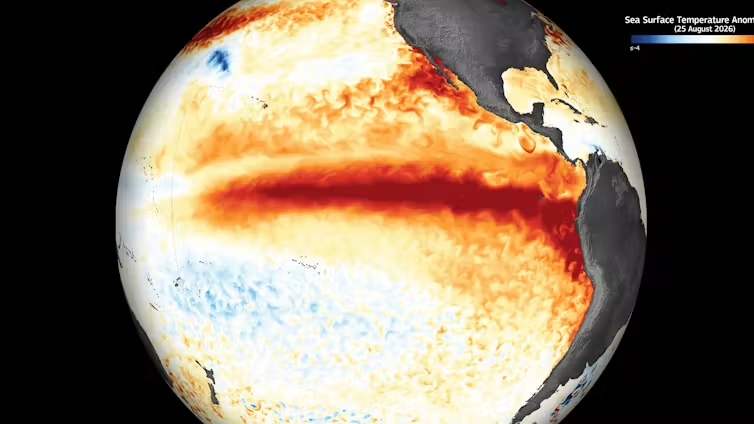
The 2026 El Niño event has set records for Pacific Ocean warming, with temperatures rising faster than in previous episodes. This warming of the Pacific Ocean has significant effects on global weather patterns. During El Niño, the trade winds that normally push warm surface water toward Indonesia weaken, allowing warm water to linger in the central and eastern Pacific. This shift in ocean temperatures has a profound impact on atmospheric conditions.
The warming Pacific during El Niño shifts moisture eastward, creating drought in the western Pacific while triggering heavy rains and floods in the eastern Pacific and beyond. The eastward-shifted moisture plume produces heavier rainfall over areas such as coastal Peru. In contrast, the western Pacific, including Indonesia, experiences reduced cloud formation and drier conditions that raise fire risk. This altered weather pattern has significant implications for regions prone to drought or flooding.
The altered circulation during El Niño also weakens the overall Walker circulation, further diminishing the pressure gradient that sustains the trade winds and reinforcing the eastward displacement of weather patterns. This change in atmospheric circulation has far-reaching effects, influencing weather patterns in distant regions. Through atmospheric teleconnections, the heated air over the central Pacific can raise temperatures in the middle and upper tropical atmosphere far from the Pacific.
One of the significant effects of El Niño is the suppression of convection over the Sahel, contributing to drought in the region. The Sahel, a region in Africa, is particularly vulnerable to drought, and El Niño events have been linked to droughts in the area. The drought in Kenya and other parts of the Sahel has significant implications for agriculture and food security.
El Niño's influence can also interact with other oceanic modes, such as the Indian Ocean dipole, which together shape rainfall over East Africa and parts of India. This interaction can have significant effects on weather patterns in these regions. However, scientists note that El Niño alone does not dictate any single day's weather, and other factors can influence the final outcome.
Another teleconnection pathway involves large-scale atmospheric ripples that travel outward from the shifted rain zone, altering wind patterns and storm tracks in distant regions. This can even affect autumn weather in Britain, highlighting the far-reaching impact of El Niño on global weather patterns. The influence of El Niño on weather patterns is complex and multifaceted.
In Kenya, the effects of El Niño are being felt, with drought in some regions and floods in others. The dual impact of El Niño is a significant concern for the region, with implications for agriculture, food security, and human settlements. Understanding the effects of El Niño is crucial for mitigating its impacts and preparing for the challenges it poses.
Key points
- El Niño causes drought in some regions and floods in others by shifting moisture eastward.
- The 2026 El Niño event has set records for Pacific Ocean warming.
- El Niño's influence can interact with other oceanic modes to shape rainfall patterns.