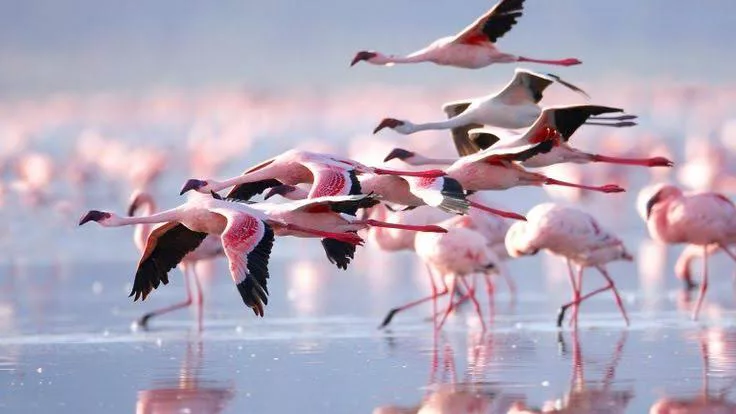
The Kenya Meteorological Department and national government have issued warnings about the impending El Niño weather pattern. In response, the government has set aside Sh1.2 billion for livestock contingency measures and an additional Sh1.5 billion for pre-positioning vaccines and veterinary drugs. These proactive measures aim to provide a crucial safety net for pastoralists and rural communities. However, a pressing ecological concern remains unaddressed: the impact of El Niño on Lake Bogoria's lesser flamingos.
Lake Bogoria, a globally recognized Ramsar Site, Unesco World Heritage Site, and Important Bird and Biodiversity Area (IBA), is home to millions of near-threatened lesser flamingos. These birds rely entirely on the lake's unique soda-rich, highly alkaline waters, which support massive blooms of microscopic blue-green algae – Spirulina – as their primary food source. The flamingos regulate the lake's aquatic environment by consuming immense quantities of spirulina, maintaining nutrient cycles within the lake.
The iconic "pink spectacle" of Lake Bogoria contributes significantly to Baringo county's eco-tourism sector, generating tens of millions of shillings annually in park entry fees, hotel bookings, and tour operations. Revenue derived from tourism directly funds community development, providing student bursaries, healthcare facilities, clean water infrastructure, and local conservancies for surrounding indigenous communities.
However, heavy floodwaters resulting from El Niño pouring into the enclosed basin will dilute Lake Bogoria's salinity and alkalinity, destroying the Spirulina blooms and effectively wiping out the flamingos' food supply. Deprived of nourishment, hundreds of thousands of lesser flamingos will be forced to abandon Lake Bogoria in search of alternative feeding grounds. Rapidly rising water levels will also submerge the shallow mudflats and shoreline feeding niches essential for both lesser and greater flamingos.
A joint bird census across seven Rift Valley lakes conducted by Nature Kenya, Kenya Wildlife Service (KWS), National Museums of Kenya (NMK), and community partners revealed a widespread decline in flamingo numbers across traditional strongholds like Lake Bogoria due to ongoing lake rise and food collapse. The survey tracked a massive migration to Lake Logipi in remote Suguta, Turkana county, which hosted an estimated 737,000 lesser flamingos, one of the largest single counts in East Africa.
The government must align emergency response with Kenya's National Recovery and Conservation Action Plan for the Lesser Flamingo (2026–2035) to extend formal legal protection to emergency refuges like Lake Logipi, fulfilling Kenya's commitments under the Ramsar Convention, Agreement on the Conservation of African-Eurasian Migratory Waterbirds (AEWA), and Convention on Migratory Species (CMS). This includes allocating funds to conduct simultaneous counts and sustained monitoring to understand flamingo movements and protect emerging breeding sites.
Protecting livestock and other wildlife while leaving the spectacle of Lake Bogoria's pink horizons to suffer the full brunt of El Niño is an incomplete disaster strategy. To build true climate resilience, Kenya must safeguard both its people, rural livelihoods, and the iconic avian heritage of the Great Rift Valley. The lesser flamingo, a symbol of Kenya's biodiversity conservation, requires urgent attention and protection.
Key points
- The Kenyan government must include the lesser flamingo in its El Niño contingency plans to prevent the destruction of their food supply and habitat at Lake Bogoria.
- Lake Bogoria's lesser flamingos are facing a significant threat due to the impending El Niño weather pattern, which could lead to the destruction of their food supply and habitat.
- The Kenyan government needs to extend formal legal protection to emergency refuges like Lake Logipi to conserve the lesser flamingo population.