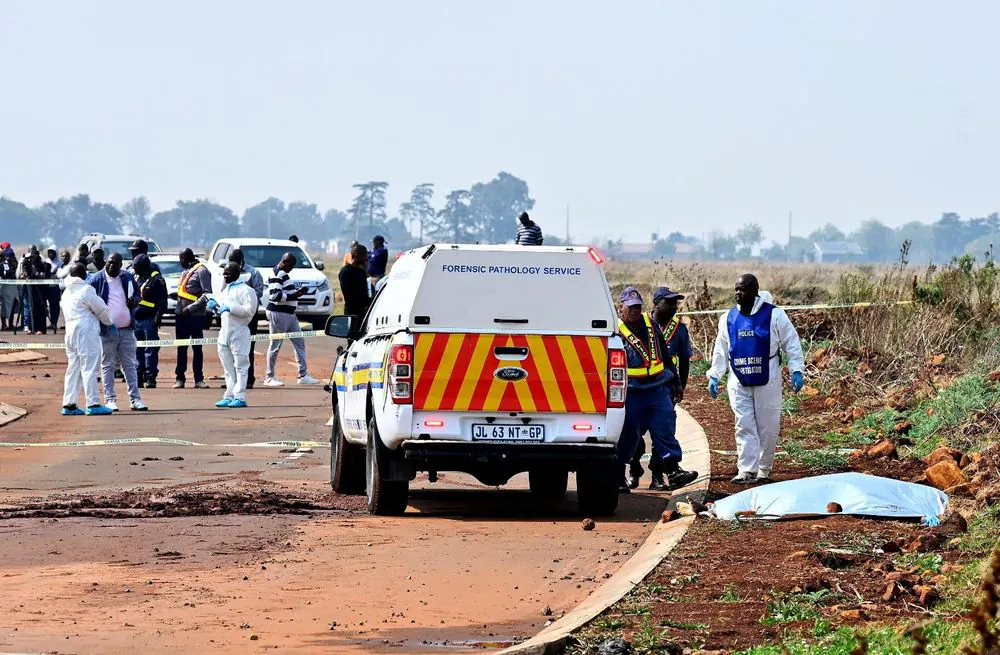
The discovery of nine women's bodies in Ekurhuleni, on the outskirts of Johannesburg, has heightened fears among women across Gauteng. The women, identified as Busisiwe Mahlangu, Itumeleng Kekana, Elizabeth “Tsontso” Moselakgomo, Dineo Evelyn Motapane, Nomfesane Mjobo, Jabulile Ntimba, Gracious Nkomo, and two others, were found in various locations over nine weeks. Their bodies were discovered in fields, beside roads, near the R21, in a river, and behind a hotel.
The latest victim, a partially clothed woman, was found in an open area on Lama Street on Thursday, September 17, with a fatal throat injury. Police have not confirmed if the cases are connected. Gender-based violence (GBV) advocates say each name represents not just a statistic but a life lost - filled with families, dreams, and future aspirations now extinguished.
Kovini Moodley, a Gauteng-based governance, risk and compliance expert and GBVF advocate, says the killings have heightened her safety concerns. As a woman and a South African who has spent years speaking about GBV, she finds the killings distressing. Moodley notes that women should not have to conduct a continuous risk assessment simply to participate in everyday life.
Moodley believes GBVF should be addressed as a systemic societal risk rather than as a series of isolated criminal incidents. She points to South Africa’s National Strategic Plan on GBVF, which includes areas such as prevention, accountability and coordination, justice and safety, response and care, and economic empowerment. However, she emphasizes the need for implementation, accountability, and measurable outcomes.
Dr. Zubeda Dangor, executive of the National Shelter Movement of South Africa, says women are afraid to go to work, afraid of taking transport, whether it is e-hailing services or walking to the bus stop. She calls on municipalities to improve public safety by ensuring adequate street lighting and maintaining overgrown grass and other areas that could provide hiding places.
Dr. Shaheda Omar, a social justice activist and child protection practitioner, says the killings are particularly distressing because of their impact on children and families. She notes that every woman killed was someone's mother, daughter, sister, partner, or caregiver, and her death reverberates through an entire family and community.
The advocates stress that government, law enforcement, communities, schools, civil society, faith-based organisations, healthcare professionals, and families all have a role in addressing GBV. They emphasize the need for a multi-faceted approach to prevent GBV and femicide, including education, community engagement, and support services for survivors.
Key points
- The discovery of nine women's bodies in Ekurhuleni has heightened fears among women in Gauteng.
- Advocates stress the need for a multi-faceted approach to prevent GBV and femicide.
- The killings have reinforced concerns about personal safety and the need for implementation, accountability, and measurable outcomes.