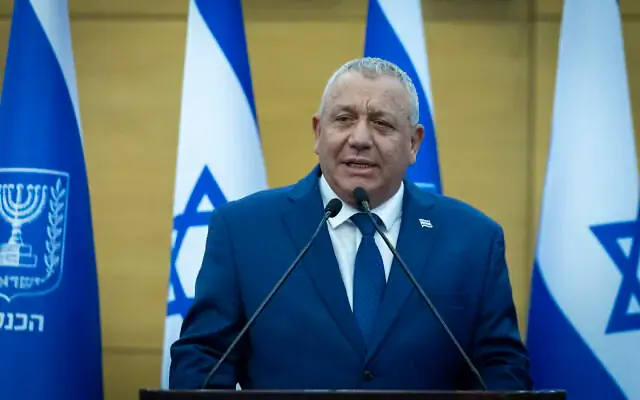
Israeli politician Gadi Eisenkot has stated that he is willing to form an emergency national government if his efforts to create a broad coalition government fail to reach an agreement. In a lengthy statement released on social media on Friday, Eisenkot outlined his plans for forming a new government after the October 27, 2026, elections. He mentioned that if ongoing talks with various parties are unsuccessful, he will establish a national emergency government that he will seek to expand before or after his swearing-in.
Eisenkot's potential emergency government may involve cooperation with Orthodox Jewish parties and the Likud party led by Prime Minister Benjamin Netanyahu. However, his plan faces challenges in securing sufficient parliamentary support, particularly due to the stance of some parties opposing a government that would rely on support from Arab parties like Ra'am and Joint List. Avigdor Liberman, leader of the Yisrael Beytenu party, has already announced that he will not vote to support a minority government reliant on Arab party backing.
Liberman's stance is shared by Sharon Sharabi, a new member of his party, who stated that she will maintain her position of not participating in a government that relies on support from parties she described as backing terrorism. Meanwhile, Naftali Bennett, leader of the B'Yachad party, has not explicitly stated that he will oppose a minority government supported by Arab parties, although he has reportedly told Eisenkot that he will not support such a government at present.
Netanyahu has continued to call for the formation of a national unity government, citing Israel's critical historical period due to security challenges, particularly with regard to Iran. He has expressed that forming a narrow government dependent on Arab party votes is unacceptable, emphasizing that Israel's security and future require political unity. However, Eisenkot has criticized Netanyahu, claiming that security issues, including tensions with Iran, are being mixed with political interests.
Eisenkot also urged Netanyahu to cease statements that he believes demean Arab parties and their supporters, warning that such language could incite violence against Israel's Arab community. According to the results of the October 27 elections, Eisenkot's coalition secured 48 out of 120 Knesset seats, while Arab parties obtained 19 seats and Netanyahu's coalition secured 53 seats.
Eisenkot has stated that he will not continue to lose time in negotiations and will present a new government to the Knesset for approval before his deadline of December 6, 2026, to form a government expires. He emphasized that he will take necessary steps, stressing that Israel's future depends on the decisions made during this period of coalition negotiations.
The development highlights the complexities of Israeli politics, with various parties holding different positions on forming a government. Eisenkot's threat to establish an emergency government adds pressure on other parties to reach a coalition agreement. The outcome of these negotiations will have significant implications for Israel's future, particularly with regard to security and political stability.
Key points
- Eisenkot may form an emergency government if coalition talks fail.
- Netanyahu calls for a national unity government citing security challenges.
- Arab parties hold 19 Knesset seats, a crucial factor in coalition negotiations.