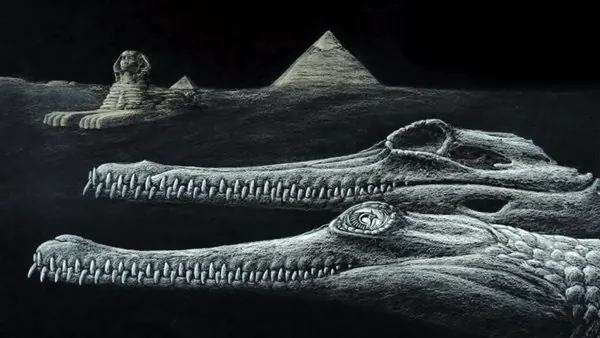
Researchers at Mansoura University in Egypt have made a groundbreaking discovery, uncovering a new species of ancient crocodile that lived around 45 million years ago. The fossil, discovered in 1927 in the El-Maqatam hills, was re-examined using modern techniques, revealing it to be a previously unknown genus of crocodile. The study, published in the Royal Society Open Science journal, was a collaborative effort between Egyptian and international researchers.
The fossil, initially known as "Tomistoma cairinensis," was found to have a distinct evolutionary history. By re-examining the fossil using advanced techniques, including digital reconstruction of the skull and comparative anatomical analysis, researchers were able to reclassify it as a new genus, "Hierogavialis." This discovery provides new insights into the evolutionary history of crocodiles in Egypt and the Mediterranean region.
The fossil is from the Eocene epoch, a period characterized by shallow and warm marine environments in Egypt. During this time, various species of long-snouted crocodiles, known as gavialians, inhabited the region. The study found that "Hierogavialis" had a distinctive skull structure, with a long snout that made up around 64% of the skull's length.
The discovery of "Hierogavialis" adds to the understanding of the diversity of gavialians that lived in Egypt, North Africa, and the Mediterranean region. The study also sheds light on the evolutionary relationships between these ancient creatures and their modern counterparts. According to Dr. Hisham Salam, founder of the Mansoura University Vertebrate Paleontology Center, the study is part of a larger project to investigate the diversity of fossil crocodiles in Egypt and North Africa.
The name "Hierogavialis" is derived from the location of the fossil discovery in the El-Maqatam geological formation, which is linked to the rocks of the Sphinx region. The name also reflects the fossil's close evolutionary relationship to the modern gharial genus. The species name "cairensis" refers to Cairo, the capital city of Egypt.
Dr. Sharif Khatter, president of Mansoura University, emphasized the importance of specialized scientific research and the university's support for research centers and international collaboration. The study demonstrates the significance of interdisciplinary research and the contribution of Egyptian researchers to the global scientific community.
The discovery of "Hierogavialis" highlights the importance of re-examining existing fossil collections and the potential for new discoveries in Egypt's rich paleontological heritage. The Mansoura University Vertebrate Paleontology Center's initiative to study Egyptian fossils abroad aims to uncover new information about the country's ancient history and contribute to the global understanding of evolutionary biology.
Key points
- The discovery of a new species of ancient crocodile, "Hierogavialis," sheds light on the evolutionary history of these creatures in Egypt and the Mediterranean region.
- The study, a collaboration between Egyptian and international researchers, used advanced techniques to re-examine a 45-million-year-old fossil.
- The discovery adds to the understanding of the diversity of gavialians that lived in the region and provides new insights into their evolutionary relationships.