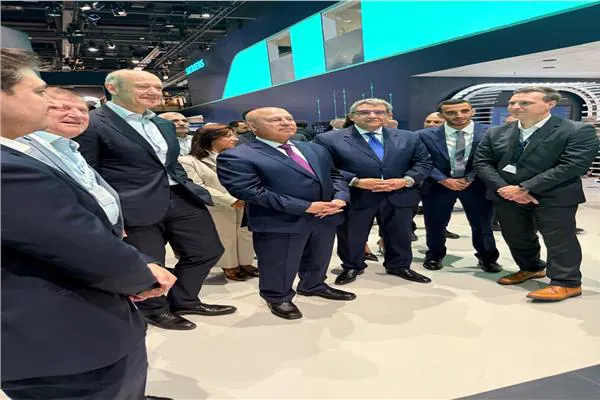
Egyptian Transport Minister Engineer Kamal El-Wazir visited the German capital Berlin to participate in the InnoTrans exhibition and conference, where he toured the Siemens booth. He was received by Ronald Porsch, Chairman of the Board of Management of Siemens, and other company officials. The two parties discussed cooperation and joint projects in transportation, railways, and electric traction.
El-Wazir then held an expanded meeting with Siemens, Orascom, DB, and Systra officials to review the executive status of the first line of the high-speed train network, which will connect Suez, El-Alamein, and Matruh. The meeting focused on the project's timeline, final arrangements, and preparations for the trial operation without passengers, set to begin in October. The trial operation will be followed by the gradual launch of the rest of the line's sections according to the specified timeline.
The meeting covered the executive status of basic infrastructure works, systems, electromechanical works, signaling, communications, and electric power supply. The parties also discussed preparations for equipping trains, stations, control, and command centers to ensure the project's readiness for trial operation without passengers, meeting the highest standards of safety, security, and quality.
El-Wazir emphasized the importance of intensifying coordination among all project parties during this stage, completing all required works, tests, and experiments in parallel with training and qualifying operation and maintenance teams. This will ensure that Egyptian cadres possess the highest levels of efficiency and readiness to operate and manage this massive project and provide the best services to passengers.
The first line of the high-speed train network, stretching 660 kilometers, will feature 21 stations and a control center. It will include 15 high-speed trains, 34 regional trains, and 14 freight locomotives, making it one of Egypt's most significant sustainable transportation projects. The line is a key component of the Suez-Alexandria logistics corridor, connecting the Suez port on the Red Sea to El-Alamein and Matruh, and supporting the transportation of passengers and goods.
The high-speed train network, consisting of four lines with a total length of 2250 kilometers, is a major addition to Egypt's green transportation network. The first three lines, spanning nearly 2000 kilometers, are currently under construction. The network will integrate with other public transportation systems, including the Light Rail Transit (LRT), metro, and railways, as well as other mass transportation projects.
Key points
- The Egyptian government aims to launch the high-speed train network in October, with trial operations set to begin on the first line connecting Suez, El-Alamein, and Matruh.
- The project is expected to provide a modern, safe, and sustainable transportation system, supporting the country's economic growth and development.
- The high-speed train network will play a crucial role in Egypt's transportation sector, enhancing the country's position as a regional hub for transportation and logistics.