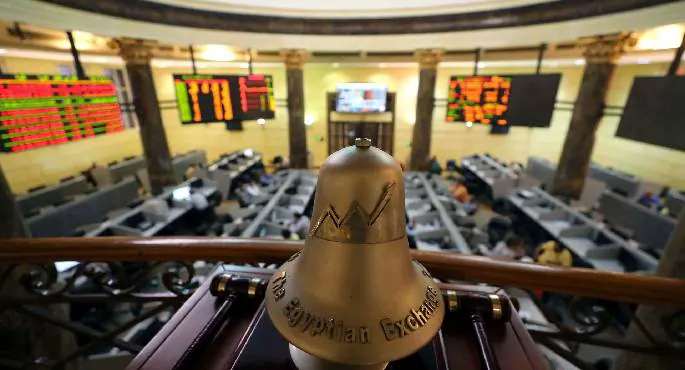
The Egyptian stock market witnessed a mixed performance at the close of trading on Wednesday, September 30, 2026. While institutional and local investment funds engaged in selling, Arab and foreign institutions, as well as individual Egyptian, Arab, and foreign investors, made purchases. This led to a loss of around 20 billion Egyptian pounds in the market capitalization of listed companies, bringing it down to 4.056 trillion pounds.
The total transactions for the day reached approximately 102.7 billion pounds, including transactions in bonds, treasury bills, and ownership transfer deals. The stock market transactions alone amounted to around 8.8 billion pounds. The fluctuations in the market were reflected in the various indices, with some experiencing declines and others recording gains.
The main index of the Egyptian stock market, EGX 30, decreased by 0.77% to reach 51,894.83 points. Conversely, the small and medium-cap index, EGX 70, rose by 1.11% to 18,625.73 points. The broader EGX 100 index also saw an increase of 0.64%, reaching 24,776.36 points.
Market analysts attributed the mixed performance to the conflicting trends of selling and buying by different investor groups. The decline in the main index was largely due to the selling pressure from institutional and local investment funds. However, the gains in the small and medium-cap index and the broader EGX 100 index were driven by purchases made by Arab and foreign institutions and individual investors.
Despite the decline in the main index, the Egyptian stock market has shown resilience in recent times. The market has been influenced by various factors, including economic reforms, interest rate changes, and global market trends. Investors are closely monitoring the market's performance, which is expected to be impacted by both local and international developments.
The Egyptian government has been implementing measures to boost the stock market and attract foreign investment. These efforts include improving the business environment, enhancing transparency, and introducing new regulations to facilitate trading. The government's initiatives aim to increase investor confidence and stimulate market growth.
Looking ahead, the Egyptian stock market is expected to continue experiencing fluctuations in response to various market and economic factors. Investors will be closely watching the government's economic policies, global market trends, and company performance to make informed investment decisions. The market's performance will also be influenced by the overall economic growth and stability of the country.
Key points
- The Egyptian stock market's main index, EGX 30, decreased by 0.77% to 51,894.83 points.
- The small and medium-cap index, EGX 70, rose by 1.11% to 18,625.73 points.
- The market capitalization of listed companies lost around 20 billion Egyptian pounds, bringing it down to 4.056 trillion pounds.