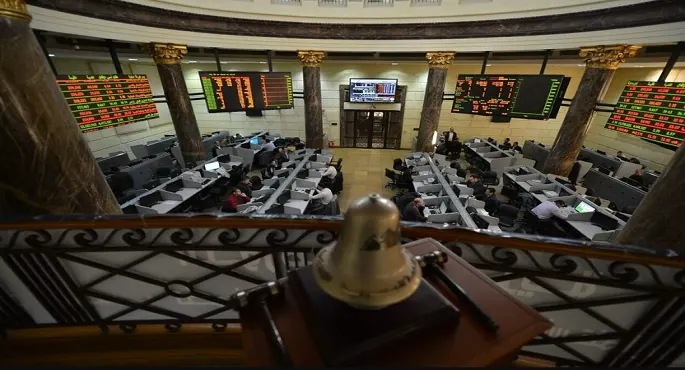
The Egyptian stock market witnessed a collective decline in its indices at the close of Tuesday's trading, driven by selling operations from Arab, foreign, and local investment institutions and funds, as well as individual Arab investors. Conversely, transactions from Egyptian and foreign individual investors trended towards buying. This led to a loss of approximately 26 billion Egyptian pounds in the market capitalization of listed companies, bringing it down to 4.213 trillion Egyptian pounds.
The overall trading value reached around 300 billion Egyptian pounds, encompassing transactions in bonds, treasury bills, and ownership transfer deals. Specifically, the stock market's trading value amounted to roughly 9 billion Egyptian pounds. The decline in market performance was reflected in the key indices, with the main index, "EGX 30," decreasing by 0.48% to reach 53,298.14 points.
The downturn extended to other indices, with the "EGX 70" index, which tracks small and medium-sized stocks, dropping by 0.68% to 19,642.65 points. Furthermore, the broader "EGX 100" index declined by 0.69% to 25,953.13 points. These changes indicate a general trend of decline in the Egyptian stock market during Tuesday's trading session.
Market analysts and investors often view such fluctuations as a natural aspect of market dynamics, influenced by a variety of factors including economic indicators, geopolitical events, and investor sentiment. The performance of the Egyptian stock market can have significant implications for the country's economy and investor confidence.
The decline in the Egyptian stock market's indices may prompt investors and market analysts to reassess their strategies and outlook for the market. It also underscores the importance of monitoring market trends and economic indicators to make informed investment decisions.
The Egyptian stock market plays a crucial role in the country's financial landscape, providing a platform for companies to raise capital and for investors to participate in the economy. As such, fluctuations in the market can have far-reaching consequences for economic growth and development.
In order to navigate the complexities of the stock market, investors and market participants must stay informed about market trends, economic indicators, and geopolitical events that can impact market performance. This enables them to make informed decisions and adjust their strategies accordingly.
Key points
- The Egyptian stock market witnessed a collective decline in its indices at the close of Tuesday's trading.
- The decline was driven by selling operations from Arab, foreign, and local investment institutions and funds.
- The market capitalization of listed companies lost approximately 26 billion Egyptian pounds, bringing it down to 4.213 trillion Egyptian pounds.