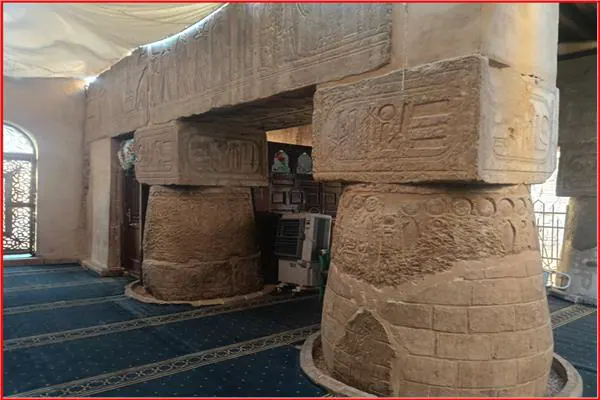
In June 2007, a fire broke out at the Abu al-Hajjaj Mosque in Luxor, damaging the dome and parts of the wooden ceiling. However, the fire led to the discovery of ancient inscriptions after restoration work began. As the layers of plaster and paint were removed from the columns and lintels, complete hieroglyphic inscriptions bearing the name of Pharaoh Ramses II suddenly appeared.
According to Abdel Jawad Hashish, former Director-General of Islamic and Coptic Antiquities, the inscriptions were in good condition, with some extending from the texts of the Luxor Temple and others written in cryptographic script that require study. The mosque itself has a complex history, having been built on top of the ancient Luxor Temple, with some of its granite columns used as supporting elements.
The Luxor Temple, where the inscriptions were found, has a rich history dating back thousands of years. The site was later occupied by a church before being converted into a mosque in the Ayyubid era in 658 AH by Abu al-Hajjaj al-Aqsr. The layers of construction and history at the site are complex, reflecting the coexistence of Muslims and Copts in the area.
The restoration work not only uncovered Pharaonic inscriptions but also Islamic artifacts. On November 22, 2007, during the removal of a floor in front of the tomb of Sheikh al-Maghribi, two Islamic tombstones were discovered. The first bore the name of Khadijah bint Sheikh al-Imrani, dated 708 AH/1309 AD, while the second belonged to Abu al-Yusr ibn Musa ibn Abu Bakr.
After the restoration, the archaeological elements were protected with glass and a lighting project was implemented. The uncovered inscriptions and artifacts became part of the scene that tourists visit. According to Abdel Fattah Abdel Allah al-Hajjaji, head of the Al-Hajjaj Youth Association in Luxor, tourists are eager to see and photograph the inscriptions.
The mosque continues to serve its religious function, with columns and lintels bearing inscriptions from the era of Ramses II. The site has become a unique blend of ancient and modern history, attracting visitors from around the world. The fire that threatened the mosque ultimately led to the discovery and preservation of the ancient inscriptions.
The discovery highlights the importance of preserving and restoring historical sites in Egypt. The Abu al-Hajjaj Mosque is a testament to the country's rich cultural heritage, with its complex history and blend of ancient and Islamic influences.
Key points
- Restoration work at the Abu al-Hajjaj Mosque uncovered ancient Pharaonic inscriptions bearing the name of Pharaoh Ramses II.
- The mosque was built on top of the ancient Luxor Temple, with some of its granite columns used as supporting elements.
- The site has a complex history, reflecting the coexistence of Muslims and Copts in the area.