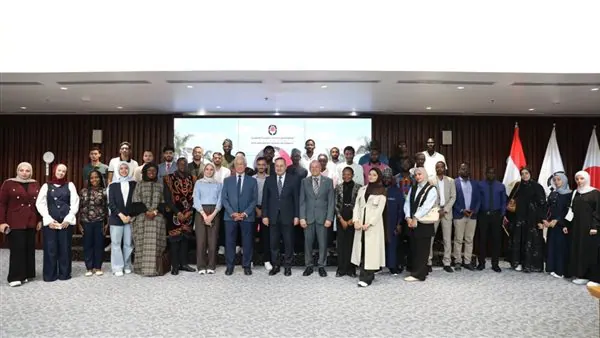
Egyptian Higher Education Minister Abdel Aziz Qansua recently visited the Egypt-Japan University for Science and Technology (E-JUST) to oversee the start of the new academic year 2026/2027. He was accompanied by Hani Hilal, Secretary-General of the Egyptian-Japanese Partnership for Education and Chairman of the University's Board of Trustees, and Ahmed El-Sabagh, President of the university. During his visit, Qansua inspected the Clean Room at the Center of Excellence for Micro and Nano Manufacturing, listening to a presentation on its research and technological capabilities.
The Minister explored the new buildings for various faculties, scheduled to be completed according to plan, which include several laboratories and lecture halls. He also visited a number of laboratories and research facilities, reviewing some of the university's research projects and applications. Qansua interacted with international students from African countries and Palestine, listening to their experiences and ensuring their academic progress.
Qansua emphasized that E-JUST represents an excellent model of Egyptian-Japanese partnership in higher education, scientific research, and technology. He highlighted the importance of the university's philosophy, which focuses on practical application and laboratory work, preparing graduates with skills that match labor market needs. The Minister stressed the need to maximize the use of the university's educational, research, and technological capabilities.
The Minister discussed the importance of continuing to develop academic and research programs in line with scientific and technological advancements. He also emphasized the need to expand project-based education and practical training, integrating theoretical knowledge with application. Qansua pointed out the significance of strengthening partnerships with Japanese universities and research institutions.
During his visit, Qansua learned about dual degree programs with Japanese universities, including a Ph.D. program with Kyushu University in Electronics and Communications Engineering. He also reviewed a Master's program with Hiroshima University in Semiconductors and other engineering disciplines. These programs reflect the depth of academic and research cooperation between Egypt and Japan.
Hani Hilal and Ahmed El-Sabagh echoed the Minister's sentiments, emphasizing the university's role as a model for Egyptian-Japanese partnership and its commitment to providing high-quality education and research opportunities. They highlighted the importance of building on past achievements and continuing to develop the university's systems to keep pace with rapid changes in higher education and scientific research.
E-JUST was established in 2010, initially offering postgraduate programs in engineering. In 2017, it began accepting undergraduate students for Bachelor's degrees. The university currently comprises several faculties, including Engineering, Basic and Applied Sciences, International Business and Humanities, Pharmacy, Art and Design, and Computer Science and Information Technology.
Key points
- The Egypt-Japan University for Science and Technology serves as a model for partnership in higher education and scientific research between Egypt and Japan.