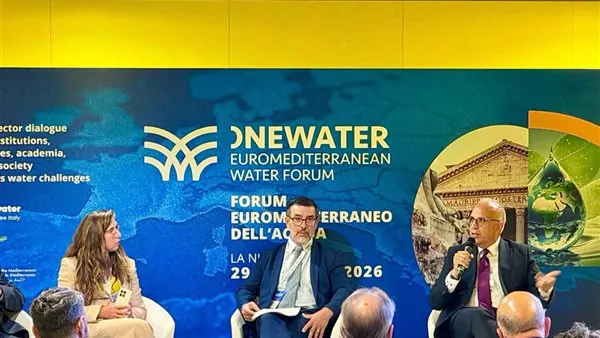
Egyptian Minister of Water Resources and Irrigation, Hani Suwelim, participated in a session titled "Promoting the Implementation of the Water-Energy-Food-Ecosystems Nexus in the Mediterranean Region" at the 2026 Euro-Mediterranean Water Forum in Rome. The session was organized by the Partnership for Research and Innovation in the Mediterranean Area (PRIMA) and discussed ways to transition the concept of the water-energy-food-ecosystems nexus from theoretical frameworks to practical applications.
Minister Suwelim emphasized that the integration of water, energy, and food represents a key approach to achieving sustainable development, given the close interlinkages between these sectors. He noted that addressing these sectors in a comprehensive manner allows for maximizing the use of available resources, enhances the ability to face common challenges, and supports the achievement of sustainable development goals.
The Minister highlighted the importance of applying the nexus approach at both regional and transboundary levels, noting that cooperation between countries and the exchange of benefits and developmental interests can lead to more sustainable and effective solutions to common challenges. He stressed that this approach is particularly important in regions that share resources and challenges, making integration and exchange of experiences a crucial path to achieving development.
Suwelim cited the Nile Basin as a model for what can be achieved through integration among basin countries, through joint action and leveraging diverse available potentials, including water resources, rainfall, agricultural land, solar energy, and wind energy. He noted that this can help address common challenges and enhance water, food, and energy security for the peoples of the basin countries.
The Minister also referenced the African Water Vision 2063, which provides a framework for African countries to move forward collectively, promoting the exchange of experiences and the development of common solutions to challenges related to water, food, energy, and climate change. He emphasized the need to expand the concept of water resources, noting that water is not limited to "blue water" in rivers and lakes but also includes "green water" from rainfall stored in the soil.
Suwelim pointed to the vast potential in the Mediterranean region in the fields of renewable energy, resources, experiences, and technology, which offers opportunities to enhance integration between north and south Mediterranean countries. He noted that cooperation among countries in the region can help develop common solutions to address the impacts of climate change and support water, food, and energy security.
Finally, Minister Suwelim stressed the importance of transforming the concept of the water-energy-food-ecosystems nexus from a theoretical framework into practical projects that achieve tangible benefits for the peoples of the region. He emphasized the need for enhanced regional cooperation, exchange of experiences, and encouragement of innovation to achieve sustainable development in Africa and the Mediterranean region.
Key points
- Egyptian Minister of Water Resources and Irrigation Hani Suwelim emphasizes the importance of integrating water, energy, and food for sustainable development.
- The Nile Basin is cited as a model for integration among countries, leveraging diverse available potentials to address common challenges.
- The African Water Vision 2063 provides a framework for collective action among African countries to address water, food, energy, and climate change challenges.