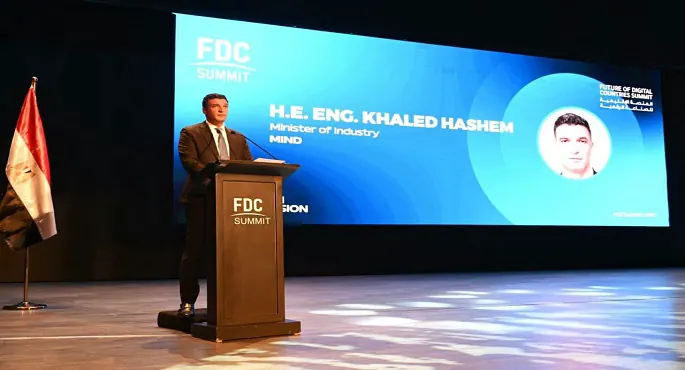
Egyptian Industry Minister Khalid Hashim attended the opening of the 8th edition of the FDC Digital Industry Summit in Cairo, where he emphasized the significance of smart manufacturing and technological transformation. The summit, held at the Al-Manarah International Conference Center, brought together various stakeholders, including ministers, ambassadors, and industry experts. Minister Hashim stressed that the current era is witnessing an unprecedented acceleration in artificial intelligence and digital technologies, creating new opportunities for growth and innovation.
Minister Hashim highlighted the importance of the summit in providing a platform for dialogue and knowledge sharing on vital issues, including artificial intelligence, cybersecurity, and the application of these technologies to support growth and investment. He emphasized that the ability to adopt technology and integrate it into production systems has become a key determinant of competitiveness and investment attraction. This, he believes, can lead to increased productivity, value-added growth, and a transition towards more advanced and competitive industries.
The Egyptian Ministry of Industry prioritizes technological update and smart manufacturing as part of its strategy to build a strong and integrated industrial base, deepen local manufacturing, increase exports, and enhance Egypt's integration into regional and global value chains. Minister Hashim noted that the development of Egypt's industry is not limited to adding new production lines but also involves building a more intelligent, efficient, and secure industry that can localize technology and compete globally.
Minister Hashim stated that the ministry aims to gradually transition from using technology in industry to participating in its development, manufacturing, and export. He emphasized the importance of supporting digital transformation applications, artificial intelligence, and industrial automation, as well as adopting smart manufacturing concepts to improve quality, efficiency, and competitiveness. The ministry also seeks to expand the role of the Industrial Modernization Center to support industrial and technological transformation.
On the sidelines of the summit, Minister Hashim and Communications Minister Ra'afat Hendy toured an exhibition featuring 60 companies from global and local technology, digital transformation, cybersecurity, and artificial intelligence sectors. The exhibition provided a platform for companies to showcase their solutions, technologies, and innovations that shape the future of the digital economy. Minister Hashim encouraged Egyptian companies to adopt technological solutions to rationalize resource use and enhance the competitiveness of Egyptian products in external markets.
Minister Hashim emphasized the importance of attracting qualitative industrial investments that involve transferring and localizing technology. He noted that Egypt's development of its digital infrastructure, expansion of communication networks, and data centers and cloud services provide a supportive foundation for smart manufacturing. The minister called on participating companies to increase their industrial and technological investments in Egypt and expand the use of secure digital applications to develop industry and enhance its efficiency.
The minister highlighted the importance of small and medium-sized enterprises benefiting from digital solutions, as they are a key element in expanding the industrial base and developing local supply chains. He also emphasized the need to secure digital systems and processes as a fundamental component of industrial security and production continuity, particularly with the increasing reliance on digital systems in factories.
Key points
- The Egyptian government is prioritizing smart manufacturing and technological transformation to enhance the competitiveness of its industry.
- The government aims to attract qualitative industrial investments that involve transferring and localizing technology.
- The development of digital infrastructure and expansion of communication networks are seen as supportive foundations for smart manufacturing in Egypt.