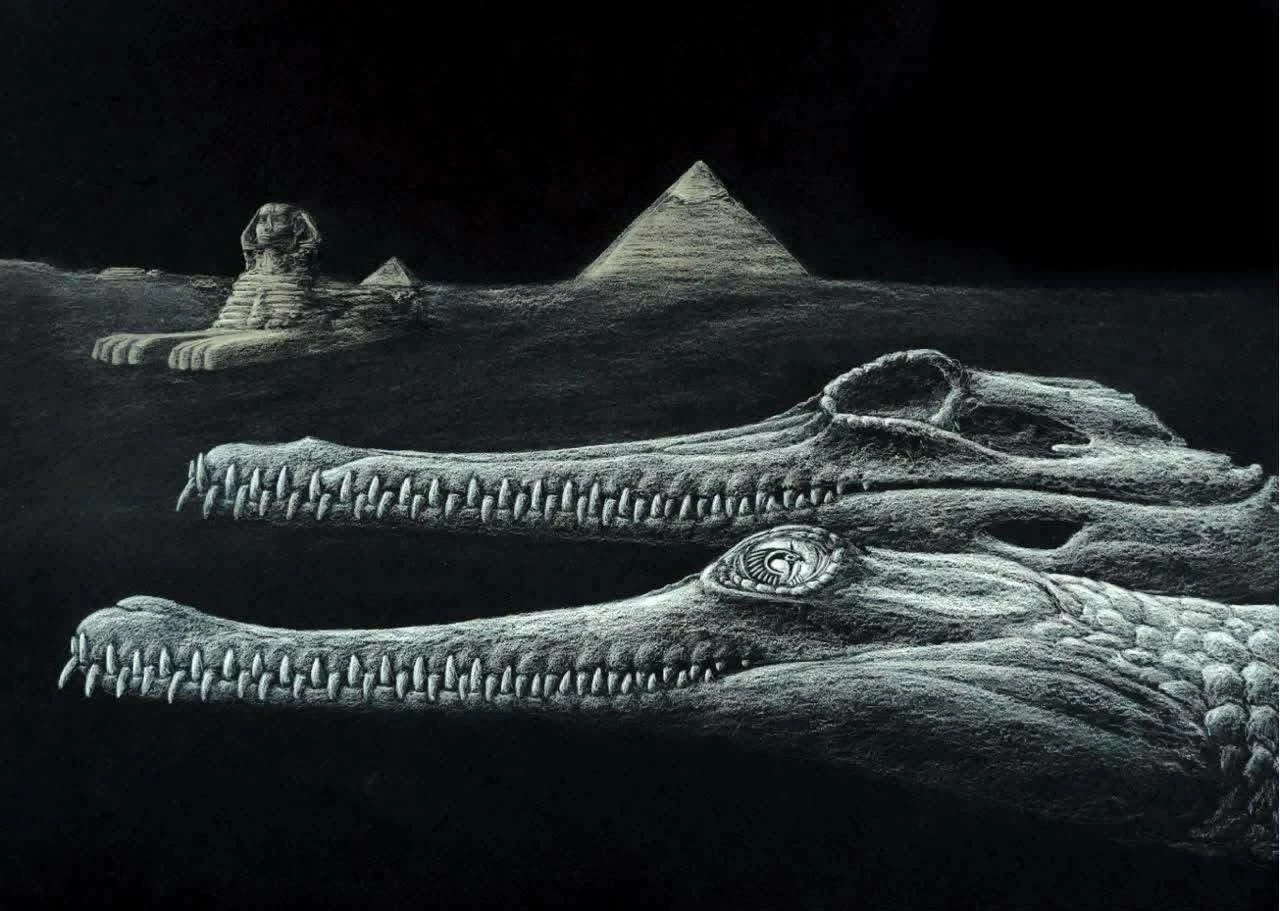
A team of international researchers, including those from the University of Mansoura's Vertebrate Paleontology Center, have re-examined a 45-million-year-old Egyptian fossil discovered in 1927 in the Mokattam Hills. The fossil, initially classified as part of the genus "Tomistoma," has been reclassified as a distinct genus called "Hierogavialis." This finding sheds new light on the diversity and evolution of crocodiles in Egypt and the Mediterranean region.
The study, published in the Royal Society Open Science journal, used advanced digital reconstruction and comparative analysis to re-evaluate the fossil. Researchers found distinct characteristics that set it apart from other known species. The fossil, now named "Hierogavialis kyrinensis," dates back to the Middle Eocene epoch and suggests that the creature lived in a shallow, warm marine environment. This provides new insights into the habitats and distribution of ancient crocodiles in the region.
The research is part of a larger project aimed at studying the diversity of fossil crocodiles in Egypt and North Africa. By combining the re-study of historical specimens with new fieldwork, scientists hope to gain a better understanding of the evolutionary history of these animals. Dr. Hisham Salam noted that many Egyptian fossil collections in European and American museums still hold significant scientific potential.
The study's findings highlight the importance of specialized scientific research in re-examining Egyptian fossils using modern techniques. University of Mansoura President Dr. Sharif Khatter emphasized the institution's commitment to supporting research centers and fostering international scientific collaboration. The discovery demonstrates the value of interdisciplinary research in advancing our knowledge of Egypt's natural history.
The research team included experts from various institutions, including Paul Berk, Sebastian Speckmann, Belal Salem, Sara Saber, Hisham Salam, and Philip Mannion. The study, titled "The Skull of the Middle Eocene Egyptian Crocodile Hierogavialis kyrinensis Provides New Insights into the Diversity of Gavialoids in the Mediterranean," was published in 2026.
This breakthrough is part of the University of Mansoura's Vertebrate Paleontology Center's efforts to re-study historical Egyptian fossils preserved outside of Egypt. By leveraging modern imaging and analysis techniques, researchers aim to enhance Egypt's presence in specialized scientific research and potentially uncover new discoveries from previously studied fossil specimens.
The discovery of "Hierogavialis kyrinensis" underscores the significance of continued exploration and research into Egypt's rich fossil heritage. As scientists continue to study and re-examine existing specimens, they may uncover further secrets about the evolution and diversity of ancient species that once inhabited the region.
Key points
- A new species of crocodile, "Hierogavialis kyrinensis," has been identified from a 45-million-year-old Egyptian fossil.
- The study used advanced digital reconstruction and comparative analysis to re-evaluate the fossil.
- The discovery sheds new light on the diversity and evolution of crocodiles in Egypt and the Mediterranean region.