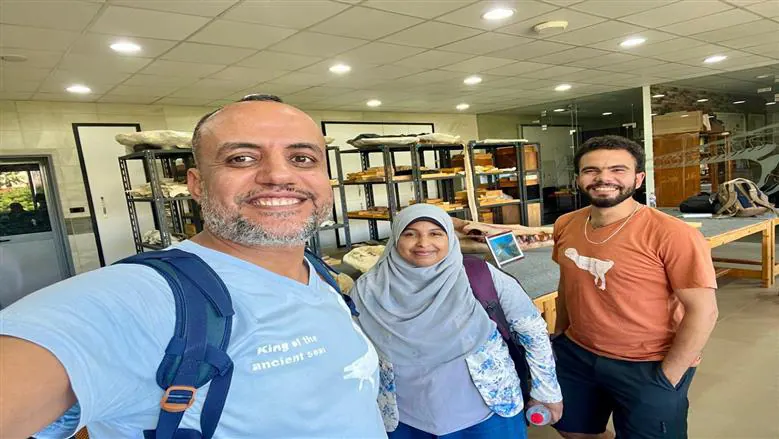
A team of researchers from the University of Mansoura has made a significant discovery in the field of paleontology, uncovering a 45-million-year-old fossil of a new species of crocodile. The fossil, named "Hierogavialis kayrensis," was found in the Gebel Qatrani formation in Egypt's Mokattam Hills. According to Dr. Hisham Salam, founder of the Vertebrate Paleontology Center at the University of Mansoura, the fossil dates back to the Middle Eocene era, a time when Egypt had shallow and warm marine environments teeming with diverse marine life.
The newly discovered species is believed to be a distant relative of the modern-day gharial, a large reptile native to the Indian subcontinent. The fossil's skull features a long, narrow snout, which accounts for approximately 64% of the skull's length. Researchers also identified distinctive anatomical features in the eye socket area and other parts of the skull. An analysis of the fossil's evolutionary relationships revealed that Hierogavialis is an early branch of the gharial family and is not directly related to African or Mediterranean species.
The discovery of Hierogavialis kayrensis has significant implications for our understanding of the evolution of crocodiles in the Mediterranean region. The fossil was found in the same geological formation as the iconic Sphinx of Giza, which dates back to the Old Kingdom period. The name "Hierogavialis" is derived from the Egyptian word "hiro," meaning Horus, the ancient Egyptian deity associated with the Sphinx. The species name "kayrensis" refers to the city of Cairo.
The research team, which included Dr. Sara Saber and Dr. Bilal Salem, used advanced imaging and analysis techniques to study the fossil. They found that the fossil's snout is remarkably similar to that of the Sphinx, which is also missing its nose. This similarity has sparked interest among researchers, who believe that the fossil may provide insights into the evolution of the Sphinx's enigmatic appearance.
The discovery is part of a larger project to study the diversity of fossil crocodiles in Egypt and North Africa. The project, led by Dr. Hisham Salam, aims to re-examine historical fossil collections and conduct new fieldwork to shed light on the evolution of these ancient creatures. The researchers hope that their findings will contribute to a better understanding of the history of life on Earth.
The study's findings have been published in the Journal of the Royal Society for Open Science, with co-authors Paul Burke, Sebastian Speckmann, Bilal Salem, Sara Saber, Hisham Salam, and Philip Manion. The research team believes that the discovery of Hierogavialis kayrensis will provide new insights into the evolution of crocodiles and their diversity in the Mediterranean region during the Paleogene and Eocene epochs.
The study highlights the importance of re-examining historical fossil collections, as new technologies and analytical techniques can reveal fresh information about ancient species. According to Dr. Salam, many Egyptian fossil collections are housed in museums and research institutions outside of Egypt, and the team is working to access and re-study these collections to gain a deeper understanding of the country's rich paleontological heritage.
Key points
- The discovery of Hierogavialis kayrensis provides new insights into the evolution of crocodiles in the Mediterranean region during the Paleogene and Eocene epochs.