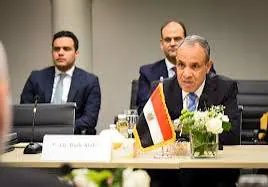
Egyptian Foreign Minister Badr Abdelatty emphasized Egypt's strategic bilateral relations with the United States, expressing a desire to enhance cooperation and elevate it to new heights, building on the momentum in their relations that serves the mutual interests of both countries. This was during his meeting with representatives of American Jewish organizations on the sidelines of the high-level segment of the 81st United Nations General Assembly in New York.
The meeting discussed regional developments in the Middle East, with Abdelatty explaining that Egypt attaches great importance to resolving all existing conflicts in the region through peaceful means and the political process, seeking to promote regional and international stability and security. He cited the Egyptian-Israeli peace treaty as an example of Egypt's strategic choice to promote peace and preserve stability in the region.
The Palestinian issue was also addressed, with Abdelatty noting that Egypt has made significant efforts in recent years, in coordination with international mediators, to contain the escalation in the region resulting from the war in Gaza, culminating in a ceasefire agreement and the convening of the Sharm El-Sheikh peace summit last year. He emphasized Egypt's fixed position on the need to implement the second phase of the agreement and allow humanitarian aid to reach Palestinians in the Gaza Strip.
Abdelatty reiterated Egypt's categorical rejection and condemnation of all Israeli unilateral measures aimed at imposing a new fait accompli in the occupied West Bank, including East Jerusalem, particularly settlement expansion and attempts to annex and change the legal and historical status quo in Jerusalem and its holy sites. He stressed that these measures constitute a flagrant violation of international law and international legitimacy decisions.
The Foreign Minister emphasized that these Israeli measures undermine the unity of Palestinian land and its geographical continuity, threatening the chances of establishing an independent Palestinian state on the lines of June 4, 1967, with East Jerusalem as its capital. He called for the cessation and reversal of these measures to serve efforts to achieve peace in the region.
The meeting was attended by Nader Zaki, the official spokesperson for the Ministry of Foreign Affairs, who provided insights into the discussions. The Egyptian Foreign Minister's engagement with American Jewish organizations highlights Egypt's ongoing diplomatic efforts to foster dialogue and understanding.
The discussions also underscored Egypt's commitment to promoting peace and stability in the region, emphasizing the importance of a two-state solution to the Israeli-Palestinian conflict. Egypt's proactive role in mediating conflicts and advocating for humanitarian assistance reflects its dedication to regional and international cooperation.
Key points
- Egypt's Foreign Minister emphasizes the importance of peaceful conflict resolution in the Middle East.
- Egypt rejects Israeli unilateral measures in the occupied West Bank.
- Egypt continues to support a two-state solution to the Israeli-Palestinian conflict.