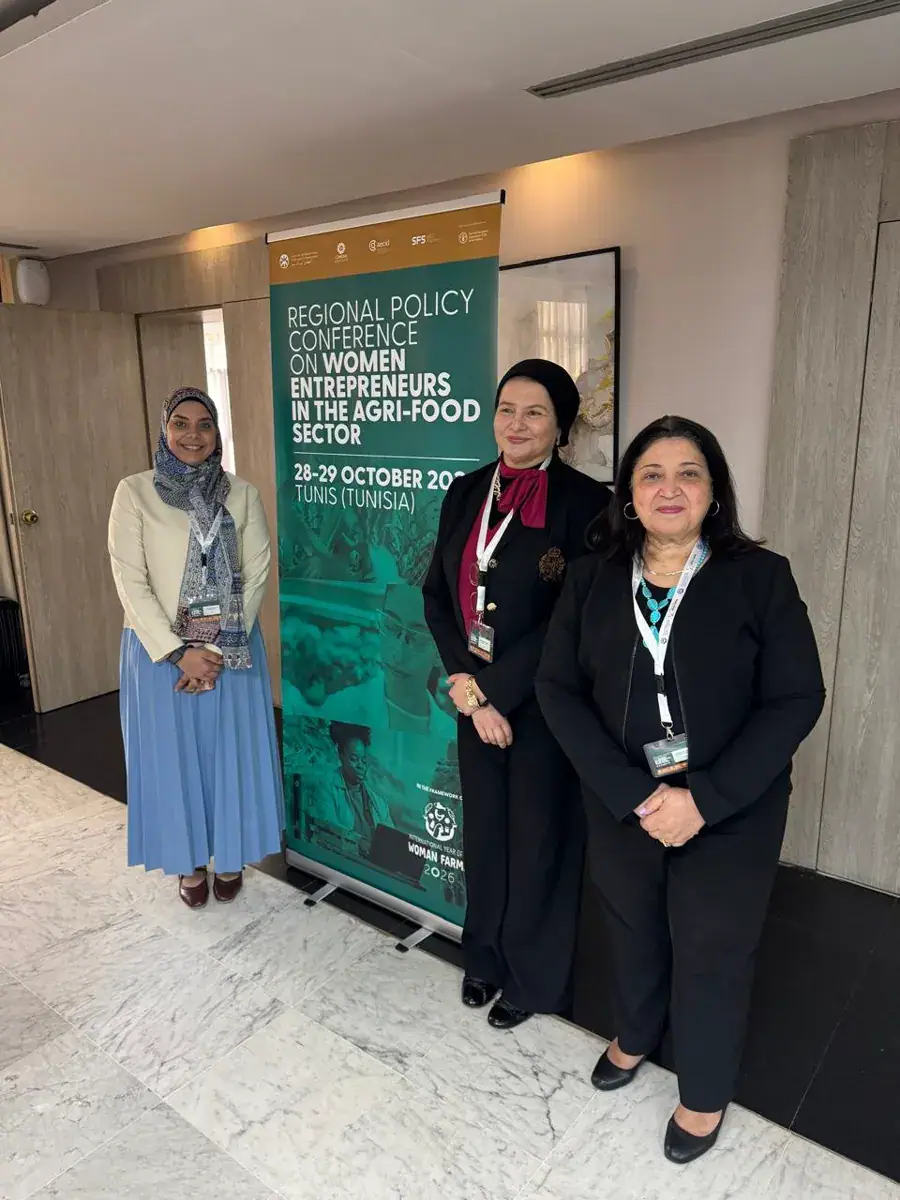
Egyptian Deputy Minister of Social Solidarity, Engineer Margret Saroufim, recently participated in a regional capacity building workshop and policy conference on innovation for female entrepreneurs in the agricultural food sector, held in Tunisia. The event was organized by the Union for the Mediterranean, the International Center for Advanced Mediterranean Agronomic Studies (CIHEAM), the Food and Agriculture Organization (FAO), and the PRIMA initiative, with financial support from the Spanish Agency for International Cooperation for Development (AECID). The workshop brought together policymakers, representatives of national and financial institutions, private sector stakeholders, civil society organizations, and female entrepreneurs from across the Euro-Mediterranean region.
During her participation, Engineer Margret Saroufim emphasized that the Egyptian government's vision prioritizes investment in human capital as the foundation of development, and that women's economic empowerment is crucial for enhancing productivity and achieving sustainable development. The Ministry of Social Solidarity adopts an approach that integrates social protection and economic empowerment, recognizing that social development is a prerequisite for building capacities, providing economic opportunities, and enabling families to improve their income.
The Deputy Minister showcased the "Project for Improving the Social, Economic, and Food Security Situation and Empowering the Most Needy Rural Communities in Minya Governorate." This project exemplifies a successful model of capacity building and partnership between the Ministry of Social Solidarity, the Ministry of Agriculture, and the FAO, with funding from the Norwegian government. The project targets over 2,000 beneficiaries in 10 villages, aiming to improve agricultural productivity, promote climate-smart agricultural practices, and support small and micro-enterprises, with a focus on women and people with disabilities.
The project has achieved significant results, including the establishment of 50 farmer field schools, with women accounting for approximately 60% of the beneficiaries. The project's approach combines practical training with production improvement, enhancing the communities' ability to adapt to climate change. This integrated approach begins with identifying the needs of the most vulnerable families, followed by training and production, ultimately leading to empowerment and sustainable income generation.
Engineer Margret Saroufim also presented another successful initiative, "Ezr3a," a collaborative effort between the Ministry of Social Solidarity, the National Alliance for Development and Humanitarian Work, the Evangelical Coptic Church, and the Ministry of Agriculture. This initiative serves as a model for promoting women's economic empowerment, particularly in rural areas, by providing support to small-scale farmers and expanding the production of strategic crops, such as wheat.
The "Ezr3a" initiative has reached its fourth season, covering 16 governorates, and has successfully supported over 500,000 farmers, cultivating 720,000 acres of wheat. This initiative demonstrates the importance of integrating social protection and agricultural development to enhance women's economic empowerment in rural areas. The Egyptian government's strategic financial framework for economic empowerment represents a supportive mechanism for integrating efforts to provide financial and non-financial services.
The regional policy agenda for 2026-2030 includes several priorities, such as promoting integration between social protection and economic empowerment, transitioning from individual initiatives to scalable and integrated development models, and enhancing regional cooperation to exchange knowledge, mobilize resources, and measure impact. The Deputy Minister concluded her speech by emphasizing the importance of exchanging practical experiences between countries and developing mechanisms to monitor and measure the impact on women's income and the sustainability of their projects.
Key points
- The Egyptian Deputy Minister of Social Solidarity participated in a regional workshop in Tunisia to discuss innovation and economic empowerment for female entrepreneurs.
- The Ministry of Social Solidarity adopts an approach that integrates social protection and economic empowerment to enhance women's productivity and achieve sustainable development.
- Egypt has launched several initiatives, including "Ezr3a," to support small-scale farmers and promote women's economic empowerment in rural areas.